
Trump's tough stance shattered expectations of a swift end to the war, while Iran responded with equal firmness, vowing to fight until the enemy surrenders. Stagflation trades are making a comeback, with some analysts predicting that the conflict will last at least until June.
Trump’s televised national address on Wednesday evening Eastern Time completely dashed investors' hopes for an imminent resolution to the Middle East conflict. Markets swiftly shifted gears: stocks fell, oil prices surged, the dollar strengthened, and risk aversion sentiment fully resurfaced.
According to reports from Xinhua News Agency, Trump stated in his speech that the United States would launch more intense strikes against Iran within the "next two to three weeks" and threatened to bomb Iran "back to the Stone Age." Although he claimed that U.S. forces were "close" to achieving all military objectives, no specific timeline for ending the conflict was provided.
 Markets had hoped for de-escalation signals from Trump’s national television address but were instead met with escalating threats. Institutions such as Nomura and NAB pointed out that no clear signs of cooling tensions emerged from the speech, and the blockade of the Strait of Hormuz is unlikely to be resolved in the short term, potentially keeping global oil prices under pressure until late April. Trump’s speech was indeed disappointing.
Following President Trump's address,$Brent Last Day Financial Futures (JUN6) (BZmain.US)$Oil prices surged 7% following the speech, touching $108 per barrel, while U.S. stock futures fell over 1%, European stocks dropped more than 2%, and almost all major indices in the Asia-Pacific region turned negative.
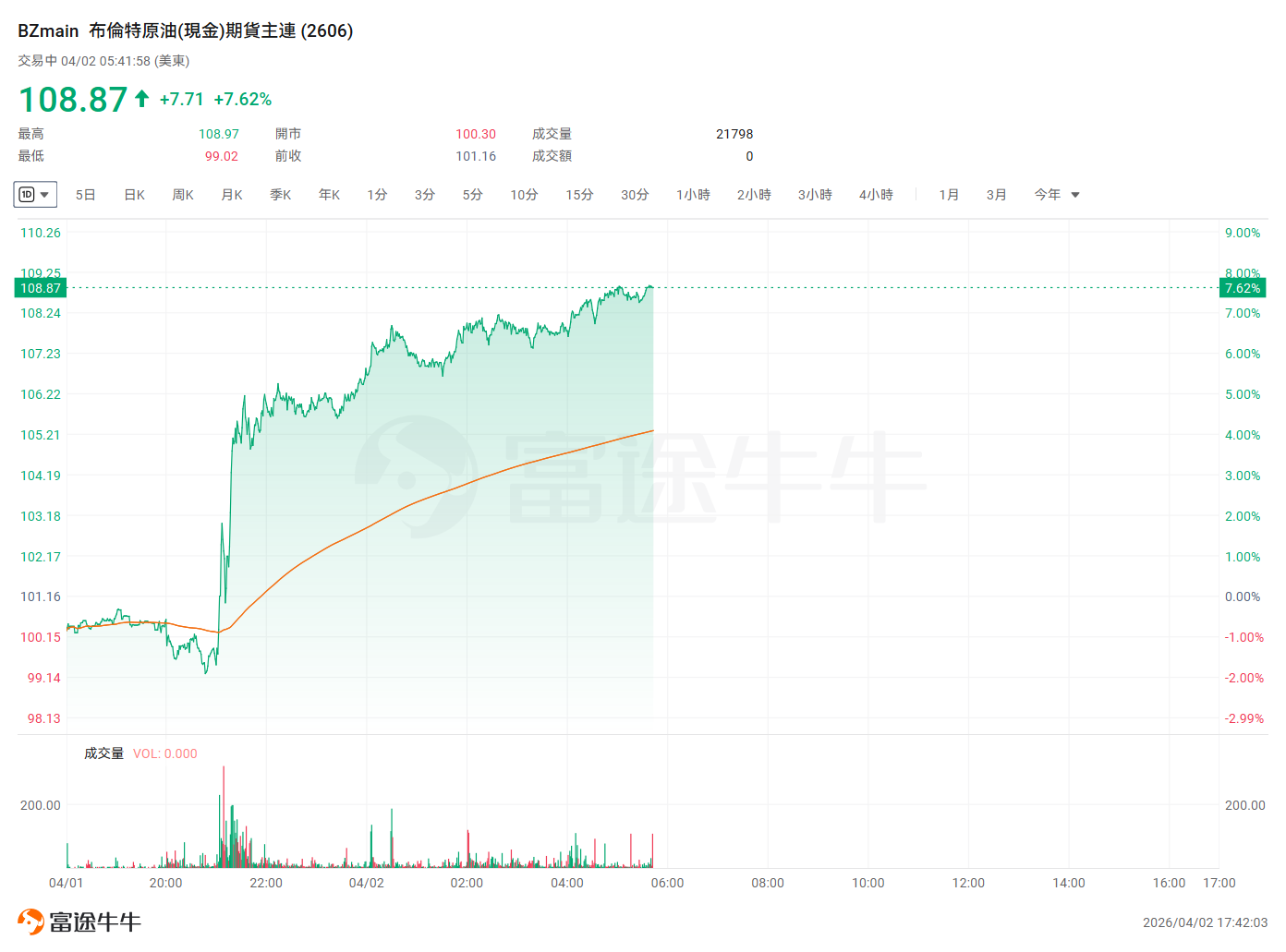
Hopes Dashed: Market Faces 'Major Disappointment'
Earlier this week, Trump signaled a possible quick end to the conflict, driving a global stock market rally and pulling the dollar back from recent highs. Investors used this window to increase their exposure to risk assets, betting on a gradual calming of hostilities.
However, Wednesday's televised address completely dismantled that logic.
"The speech itself did not contain much new information; the key point is that he confirmed another two to three weeks of fighting," said Mike Houlahan, director of Electus Financial Ltd in Auckland. "This pushes the timeline for the end of the conflict further out." He further noted that whether this extension would add additional pressure on fuel supply chains would be the next issue worth monitoring.
The strategy team at Westpac pointed out that this speech undermined the prospects for de-escalation, and they further noted:
"If anything, the speech reintroduced the threat of a more 'decisive final blow' before unilaterally ending the conflict."
Amid the upcoming Easter long weekend, traders who had previously increased their positions rapidly unwound them, exacerbating market volatility.
Prospects for a ceasefire remain unclear as parties maintain entrenched positions.
Following the speech, there were no signs of any substantive easing in diplomatic tensions.
According to CCTV International citing Iran's Tasnim News Agency, Iran’s armed forces issued a warning that they would launch a "more devastating and larger-scale" counterattack. An official Iranian statement declared that the war would continue until the enemy faced "permanent regret and surrender."
Meanwhile, the Israeli military reported detecting missiles fired from Iran, while Saudi Arabia and Abu Dhabi intercepted incoming drones or missiles on the same day. The U.S. Embassy in Baghdad urged its citizens to leave Iraq.
On the diplomatic mediation front, Reuters cited Pakistani security sources stating that Islamabad had proposed a temporary ceasefire plan, but no response has been received from either side.
Sources familiar with the matter revealed that U.S. Vice President JD Vance recently relayed a message via Pakistani intermediaries on Tuesday, indicating that Trump would accept a ceasefire plan under specific conditions. However, a senior Iranian source told Reuters that Tehran insists on securing a guaranteed ceasefire agreement.
Analysts noted that if Trump were to unilaterally end the war without an agreement, Iran might instead benefit from a stronger stance and greater leverage.
The unresolved energy crisis is fueling the risk of stagflation.
What disappointed the market most in Trump's speech was the absence of any mention of reopening plans for the Strait of Hormuz. This critical waterway, which carries about one-fifth of the world's oil and liquefied natural gas trade, has triggered one of the most severe global energy supply shocks in history following Iran’s blockade.
Matt Simpson, a senior market analyst at StoneX in Brisbane, stated, "With the effective closure of the Strait of Hormuz and no reopening plans in sight, oil prices will remain elevated over the long term," and markets will have to face "a new wave of inflation."
The combination of high oil prices and slowing economic growth is intensifying the risk of stagflation. The yield on the 10-year U.S. Treasury note rose by 5 basis points to 4.376% after Trump's speech, reflecting growing concerns about the inflation outlook that are narrowing the scope for accommodative monetary policy.
Toichiro Asada, a newly appointed member of the Bank of Japan, also warned this week that the war with Iran could expose Japan to stagflation risks that would be difficult to address through monetary policy. Chesler stated:
"We are entering a stagflation scenario characterized by low growth and high inflation expectations."
Will the war continue until June?
Amidst intertwined uncertainties, analysts generally expect the market to maintain a risk-averse pattern in the short term.
Carol Kong, a currency strategist at Commonwealth Bank of Australia, stated, "Given our expectation that the war will last at least until June, the U.S. dollar is well-positioned to strengthen further."
She also noted, "It is indeed hard to feel optimistic about the trajectory of the war, as Israel and Iran are, after all, the other two parties involved in the conflict—not just the United States."
Oil prices and the US dollar are regarded by analysts as the most supportive assets in the near term, while risk assets will remain under pressure until there is a clear turning point in the situation. Currently, the most critical answer the market is waiting for—when the war will end—remains unknown.
Editor/Rocky