
UBS Group believes that if international oil prices break through $150 per barrel and remain at that level, the US and global markets will face significant systemic risks, with the probability of a recession and sharp market adjustments increasing substantially. The danger of this threshold lies in its potential to trigger a complete negative cycle: 'high oil prices → rebound in inflation → tightening of monetary policy → deterioration of financial conditions → collapse in demand → market panic.'
As geopolitical tensions in the Middle East continue to escalate, every increase in international oil prices is testing the limits of global market resilience. UBS Group has drawn a clear red line in its latest research report: $150 per barrel.
According to TradingView, a recent global macroeconomic research report by UBS Group analysts indicated that if international oil prices break through $150 per barrel and remain at that level, the United States and global markets will face significant systemic risks, with a sharply increased probability of recession and severe market adjustments.
 The bank emphasized that the danger of this critical threshold lies in its ability to trigger a complete negative feedback loop: 'High oil prices → Inflation rebound → Tightening monetary policy → Deteriorating financial conditions → Collapsing demand → Market panic.'
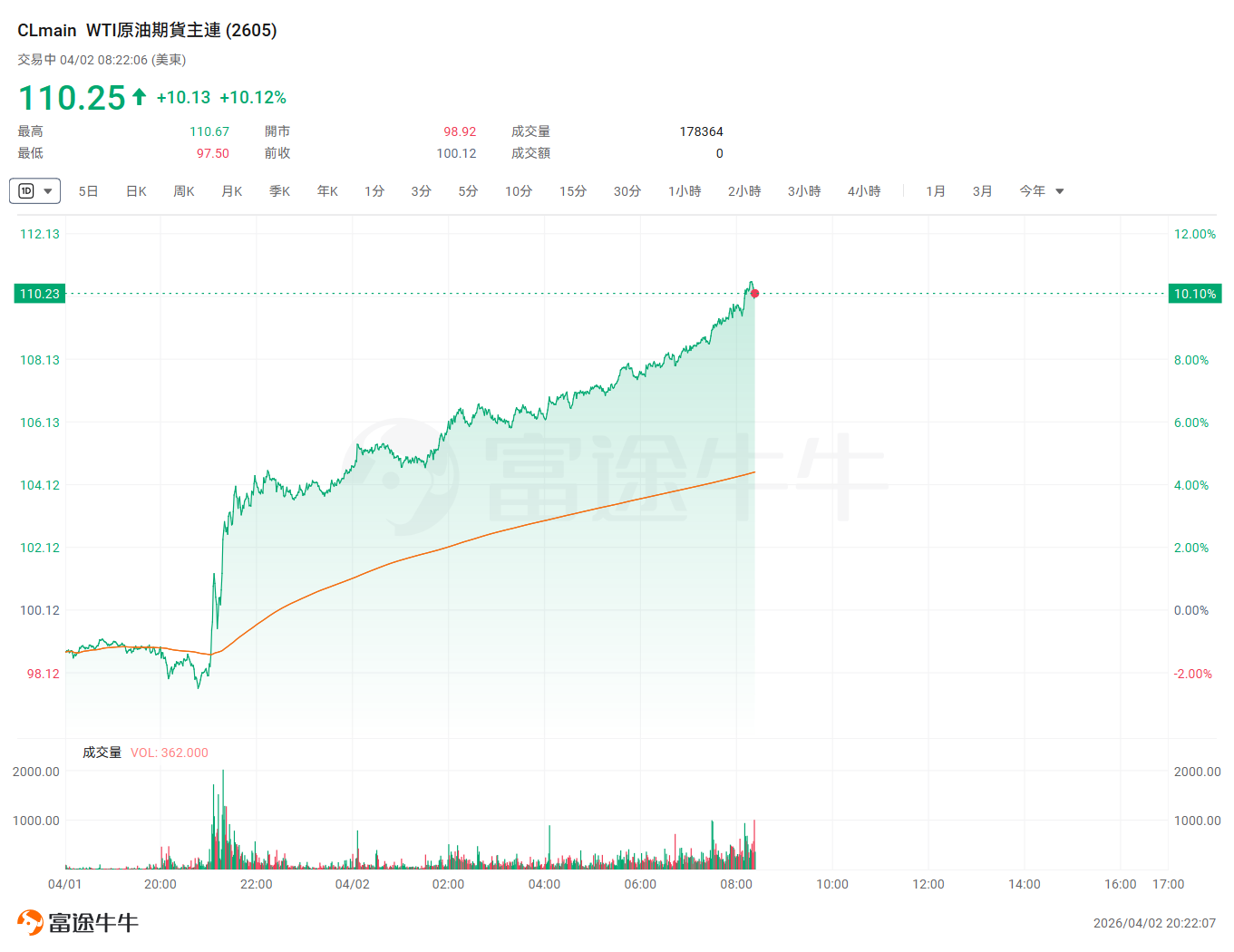
As of press time, the international benchmark Brent crude oil surged over 10%, once again breaching the $110 mark. UBS Group warned that the current market pricing of oil price risks remains skewed towards linear extrapolation, significantly underestimating the cliff-like risk near $150 per barrel. Amidst the shadow of high oil prices, the market has little safety margin left; safeguarding risk thresholds and avoiding highly sensitive assets is more critical than pursuing returns.
Impact depends on initial vulnerability.
The UBS Group research report shattered the market's long-standing linear assumption that 'every $10 increase in oil prices drags down the economy by a fixed proportion,' pointing out that the destructiveness of energy shocks is highly dependent on the initial state of the economy.
The current global economy is in an environment of high interest rates, weak recovery, and tight credit conditions, with an already non-negligible initial probability of recession, which significantly amplifies the transmission effects of oil price shocks.
UBS Group constructed a three-dimensional analytical framework using the comprehensive probability of recession in the United States, the magnitude of oil price increases, and the cyclical downturn in the economy as the three dimensions. The results clearly revealed the non-linear characteristics of the risks:
When the probability of recession is 20% and oil prices are at $100 per barrel, the cyclical economic downturn is only 0.28 standard deviations, indicating a mild impact.
If the probability of recession rises to 40% while oil prices remain at $100 per barrel, the magnitude of the downturn expands to 0.81 standard deviations, nearly three times the baseline.
When the probability of a recession reaches 40% and oil prices exceed $150 per barrel, the downside surge amounts to 1.4 standard deviations, with the impact intensity nearly five times the benchmark.
This implies that the more vulnerable the economy is, the more severe the blow from high oil prices becomes. In the current environment, an increase in oil prices from $100 to $150 does not result in merely a 50% rise in pressure but rather multiples of risk accumulation.
$150: The Critical Threshold Under Two Scenarios
Based on UBS Group’s estimate of about a 30% probability of a US recession prior to the Middle East conflict, two key scenarios reveal critical thresholds, with the gap between them highlighting the pivotal role of financial market reactions.
In an ideal steady-state scenario, if financial markets remain stable without additional risks escalating, the US economy could theoretically withstand oil prices rising to approximately $200 per barrel before entering a substantive recession. However, under real-world risk scenarios, once stock markets experience sharp corrections due to high oil prices and risk appetite deteriorates rapidly, the recession threshold would drop directly to $150 per barrel.
UBS Group notes that once $150 per barrel is reached, the world will face three layers of systemic pressures:
At the macro level, inflation will surge again, forcing central banks to interrupt or even restart interest rate hikes, pushing the economy quickly toward stagflation.
At the market level, earnings expectations for equities will be revised downward, valuations will contract, credit spreads for high-yield bonds will widen, and tightened liquidity will trigger cross-asset sell-offs.
At the real economy level, corporate costs will soar, profit margins will be squeezed, household purchasing power will decline, and both consumption and investment will cool simultaneously, resulting in a synchronized downturn across the economy and markets.
The research report also references historical comparisons, pointing out that larger oil price shocks prior to 2000 had a lesser impact than those during the 1990 Gulf War due to stronger initial economic resilience. Today, amid persistently high global interest rates, the financial system is more sensitive to cost increases, making the impact of a $150-per-barrel shock even more severe.
Nonlinear Risks: Blind Spots in Market Pricing
A research report from UBS Group specifically warns that the current market systematically underestimates the risks associated with oil prices, particularly overlooking the threshold effects near the $150 per barrel mark.
According to UBS research, the range between $100 and $130 per barrel primarily impacts specific industries, such as aviation, logistics, and chemical sectors, exerting pressure on these segments while the overall market remains manageable; however, once oil prices stabilize above $150 per barrel, risks will escalate from localized to systemic, evolving from sector-specific challenges into broader financial systemic risks.
These nonlinear risks manifest across three dimensions:
First, the acceleration of risk transmission, where high oil prices rapidly erode the buffers of corporate profitability, consumer spending, and government fiscal capacity;
Second, the compression of policy space, as rising inflation forces central banks into a dilemma of balancing "inflation control versus economic stability," leaving them unable to timely support the market;
Third, the acceleration of confidence collapse, where significant stock market corrections and credit risk exposure compound, forming a negative feedback loop of "decline → deleveraging → further decline."
Looking to pick stocks or analyze them? Want to know the opportunities and risks in your portfolio? For all your investment-related questions,just ask Futubull AI!

Editor/Jayden