
Over 4 billion USD in redemption requests cannot be fulfilled! Two private credit funds under Blue Owl have faced large-scale withdrawal requests. Redemption requests for OCIC accounted for 21.9%, while those for OTIC, which focuses on the technology sector, reached as high as 40.7%. Such a high redemption ratio is unprecedented among major institutions. Blue Owl has decided to enforce a 5% cap on tender buybacks.
The private credit market is undergoing an unprecedented redemption stress test.
$Blue Owl Capital (OWL.US)$ Two private credit funds under Blue Owl faced massive redemption requests, with Blue Owl Credit Income Corp. (OCIC) seeing redemption requests accounting for 21.9%, and Blue Owl Technology Income Corp. (OTIC), which focuses on the technology sector, experiencing redemption requests as high as 40.7%.
 Such high redemption ratios are unprecedented among major institutions in the market. In response to this situation, Blue Owl announced the activation of a redemption cap mechanism, limiting the redemption ratio of both funds to 5%.
This directly affects a large number of investors. For the OCIC fund, approximately $3.2 billion in redemption requests will not be fulfilled; for the OTIC fund, about $1 billion will remain unfulfilled.
Blue Owl attributed this to 'growing market concerns about the potential impact of AI on software companies.' This incident has placed Blue Owl at the center of a confidence crisis in the private credit industry, with pre-market declines widening to 10%.
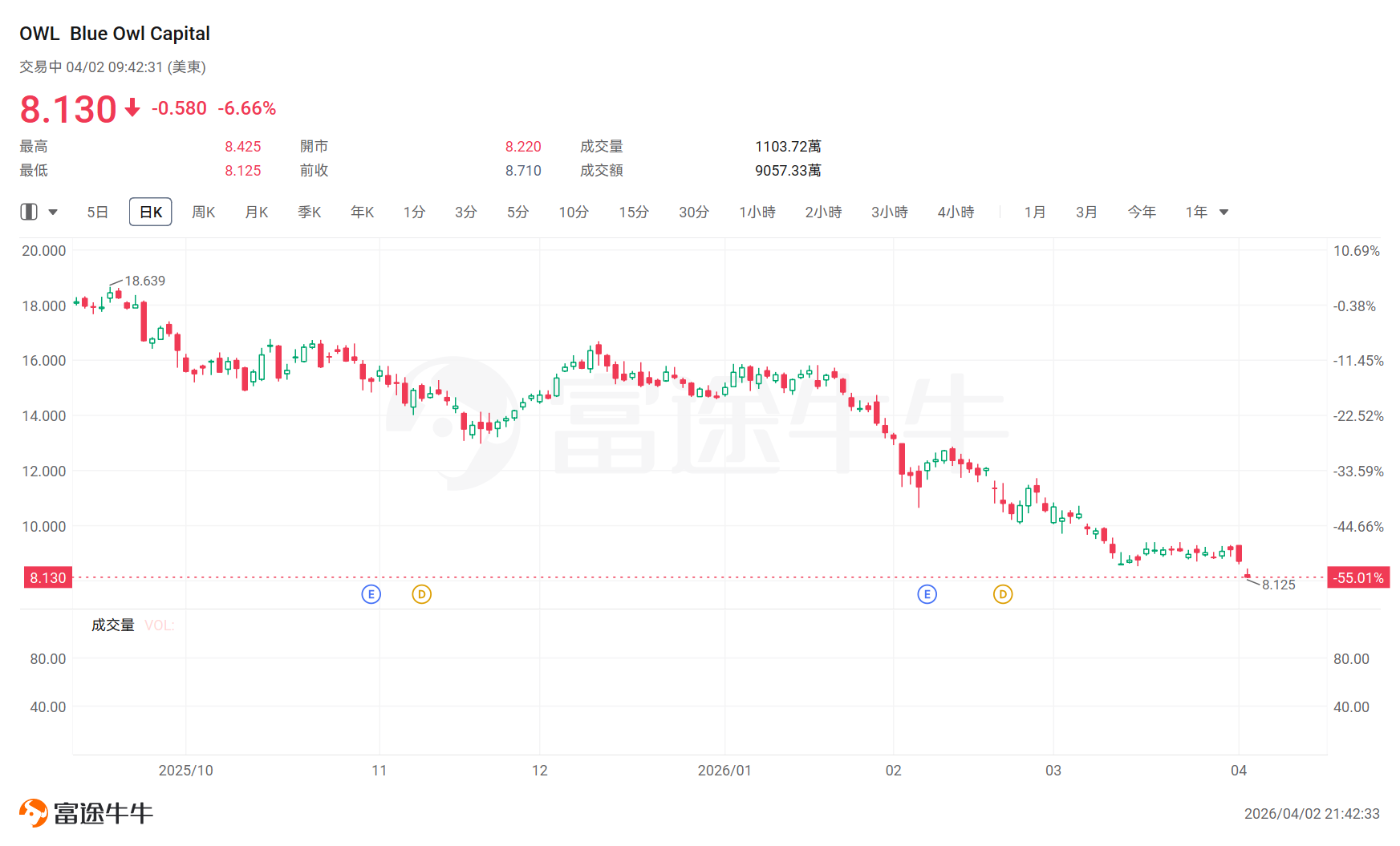
Surging redemption requests set a record among major institutions in the industry.
According to investor letters, during the three months ended March 31 this year, the $36 billion OCIC received redemption requests accounting for 21.9%, sharply up from 5.2% in the previous quarter; the redemption request ratio for OTIC was even higher at 40.7%, compared to 15.4% in the previous quarter.
Both funds had previously exceeded the 5% tender offer repurchase limit, with Blue Owl voluntarily meeting additional redemption requests. However, given the unprecedented scale of redemptions this time, Blue Owl decided to enforce the standard cap mechanism within the framework of the fund contract.
Under the 5% cap, the actual amount redeemed for OCIC was approximately $988 million, while about $3.2 billion in redemption requests went unmet, with the related funds remaining in the fund.
The actual redemption amount for OTIC was approximately $179 million, with about $1 billion of investor funds also retained.
The industry has widely imposed redemption limits, but Blue Owl's pressure is particularly prominent.
Blue Owl is not the first institution to initiate a redemption cap.
Private credit giants such as Apollo Global Management, Ares Management, and BlackRock have previously implemented identical redemption thresholds for their non-traded Business Development Companies (BDCs).
However, the scale of Blue Owl's redemption requests is so large that it stands out significantly among its peers.
Analysts note that this data reflects deep concerns in the market regarding the quality and liquidity of private credit assets, with Blue Owl now at the center of this industry-wide trust crisis. For investors holding non-traded BDC products, this event serves as another reminder of the structural limitations in liquidity management inherent to such products.
However, the current situation is delicate, as investment firms and the Trump administration are actively pushing to include private credit and private equity in 401(k) retirement savings plans. The Treasury Department announced on Wednesday that it would convene a meeting of regulators to discuss the risks and market outlook for the industry.