
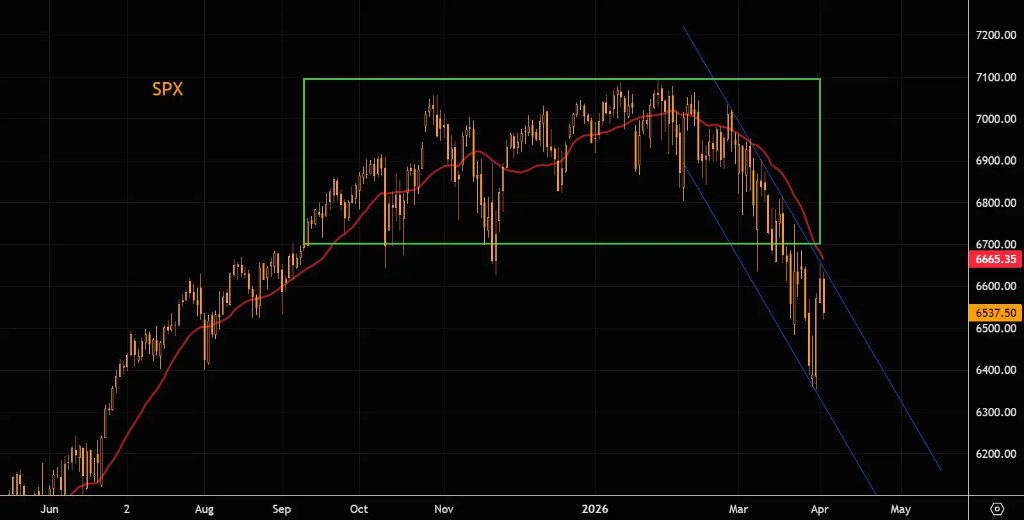
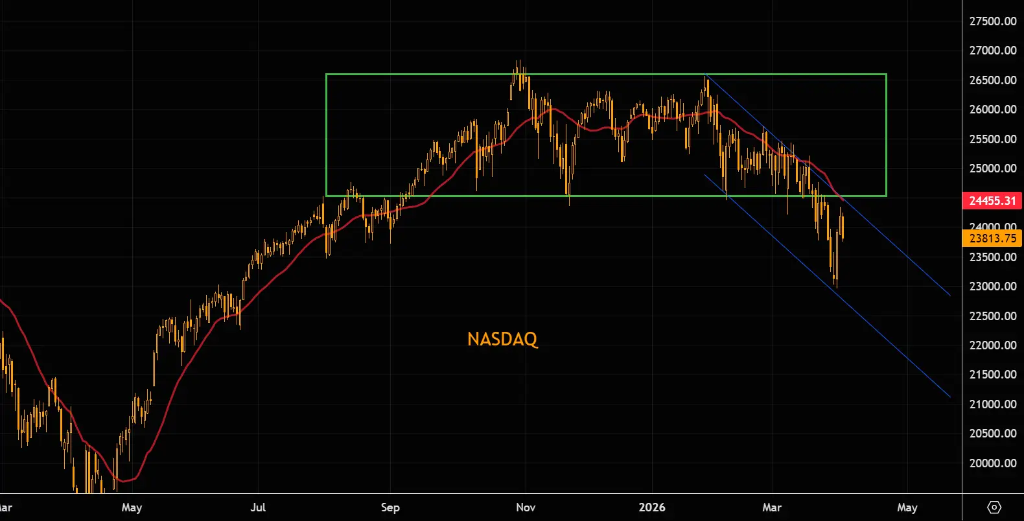
The brief rebound in the US stock market faced suppression at a key resistance level, with both the S&P 500 and Nasdaq reversing their trends. Previous support levels have now turned into resistance levels, signaling a clear 'false breakout.' Market makers' negative Gamma exposure has reached as high as $7 billion, compounded by liquidity depletion, indicating fragile market structure. The VIX remains at an elevated level of 27, while geopolitical risks continue to escalate.
The brief rebound in the U.S. stock market encountered a 'clean knockout' at a key resistance level, with structural vulnerabilities in the market gradually accumulating.
$S&P 500 Index (.SPX.US)$Both the Nasdaq Index and other indices reversed downward at technical resistance levels. Market makers' positions are highly skewed toward the downside, liquidity continues to deteriorate, and the market is in a fragile critical state—any additional shock could trigger a rapid decline.
 Specifically, the S&P 500 Index experienced a clear reversal after touching the 21-day moving average and the upper boundary of the downward channel. The Nasdaq’s movement was almost identical, with previous support levels now turning into strong resistance. This 'failed rebound' sends an important signal: the technical recovery logic that the market had been counting on is facing severe challenges.
Meanwhile, geopolitical risks continue to escalate. Trump stated that an extremely severe strike against Iran will be carried out within the next two to three weeks, causing oil prices to surge sharply and further exacerbating market uncertainty.
Technical breakdowns on both fronts, and the rebound logic collapses.
Both the S&P 500 Index and the Nasdaq Composite displayed a clear 'false breakout' pattern on the technical side. According to LSEG Workspace data, both indices reversed after testing the upper boundary of the steep downtrend channel and the 21-day moving average, with the previously perceived upward momentum quickly dissipating.
The situation with the Nasdaq is particularly noteworthy: the previous range support lows have fully converted into resistance, indicating that the conditions required for structural market repair remain unmet. From a technical trading perspective, the channel trading strategy that has been effective over recent weeks once again faced suppression at the upper boundary, further reinforcing the bias toward downside operations.
Two mechanisms reinforce each other, and downside risks in the market accumulate.
In the current market structure, two key mechanisms are reinforcing each other, making downside risks impossible to underestimate.
According to Goldman Sachs data, market makers hold approximately negative $7 billion in Gamma exposure for the S&P 500 Index, marking the second-largest short Gamma reading on record. Under this mechanism, market makers are forced to sell during declines and buy during rallies, contrary to the stabilizing mechanisms of normal markets, significantly amplifying price volatility.
Meanwhile, market liquidity remains at a low level. Data from Goldman Sachs shows that the current shallow market depth implies even moderately sized orders could disproportionately impact prices. This factor, often underestimated by the market, is a key reason for the frequent abnormal fluctuations in recent price movements.
Although the VIX has cooled, market pressure has not dissipated.
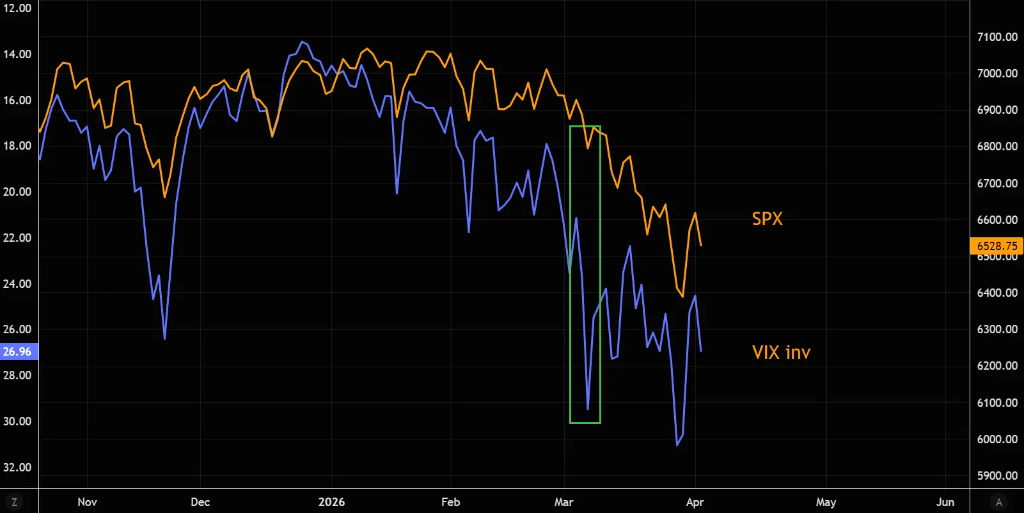
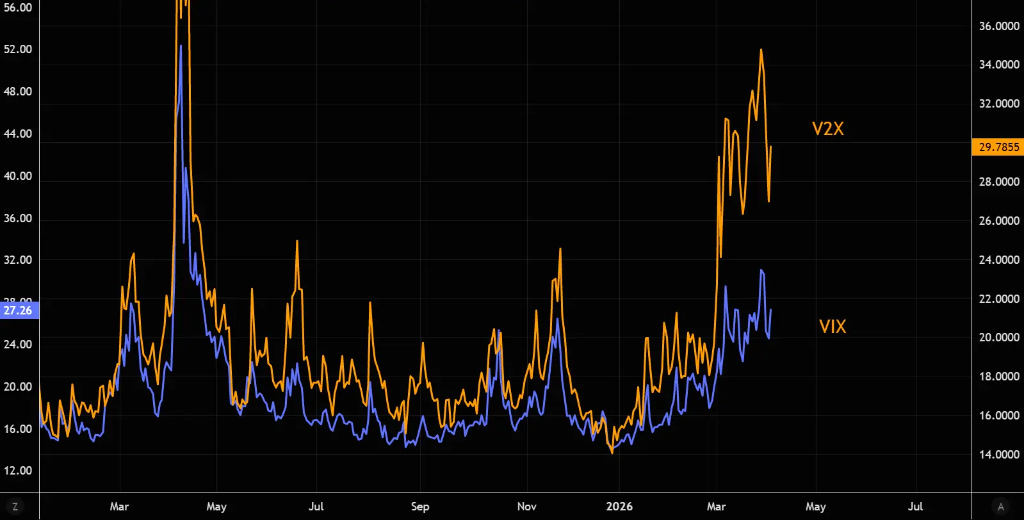
In terms of volatility, the VIX spike seen in early March has significantly receded, but the current reading of 27 still conveys a clear signal of stress. This level is sufficient to maintain a protective sentiment in the market, yet it has not reached the panic threshold, meaning the market may continue its gradual decline without a sharp increase in volatility.
Concerns are more pronounced in European markets. The persistent gap between the European volatility index V2X and the VIX, coupled with the latest developments regarding Iran, further exposes the fragility of European assets. In this round of global risk asset adjustments, Europe remains in a relatively weaker position.
Amid intertwined pressures, the market has entered a highly sensitive phase.
Considering the factors above, the current market landscape can be summarized across four dimensions: failed technical rebounds, market maker hedging mechanisms amplifying volatility, liquidity shortages magnifying price shocks, and ongoing spillover effects from geopolitical risks. Together, these elements form a relatively fragile market structure.
From an operational perspective, in an environment where market makers have deep short exposures and liquidity is thin, if the market weakens further, the speed of decline could accelerate faster than anticipated. For investors holding positions, the priority of dynamically adjusting protective positions is rising; for those on the sidelines, it is still not the right time to consider bottom-fishing lightly.
Editor/Rocky