
①Although the number of ships passing through the Strait of Hormuz has been increasing over the past week, there are still two “taboos” at play: ②The three vessels attempting to cross the Strait of Hormuz on Thursday seem to be breaking these two “taboos,” a development that is drawing significant attention from the global energy and shipping industries…
Although the number of ships passing through the Strait of Hormuz has been increasing over the past week, there are still two “taboos” at play:
Firstly, since the outbreak of the US-Iran conflict, no LNG (liquefied natural gas) vessel has crossed the strait; additionally, ships passing through the strait mostly have to take the “northern route,” which runs between Iran’s Larak Island and Qeshm Island, placing them under almost constant close surveillance by Iranian forces…
 However, the three vessels attempting to cross the Strait of Hormuz on Thursday seem to be breaking these two “taboos,” a development that is drawing significant attention from the global energy and shipping industries…
Is the first LNG vessel attempting to cross the strait emerging?
It has been reported that an LNG carrier entered the Strait of Hormuz on Thursday. If it successfully completes the crossing, it will become the first such vessel to traverse the strait since the outbreak of the current US-Iran conflict.
Vessel tracking data indicates that the LNG carrier, named “Sohar,” appears to be empty and is heading east after changing its destination to Oman's Qalhat LNG export terminal. The data shows that this Omani-flagged vessel has been lingering near the Persian Gulf for the past month.
The latest information obtained by the vessel tracking website Vesselfinder shows that the ship was 16 hours ago in the final leg of its passage through the strait—having just passed the northern tip of Oman's Musandam Peninsula—before ceasing transmission of its automatic positioning signals.
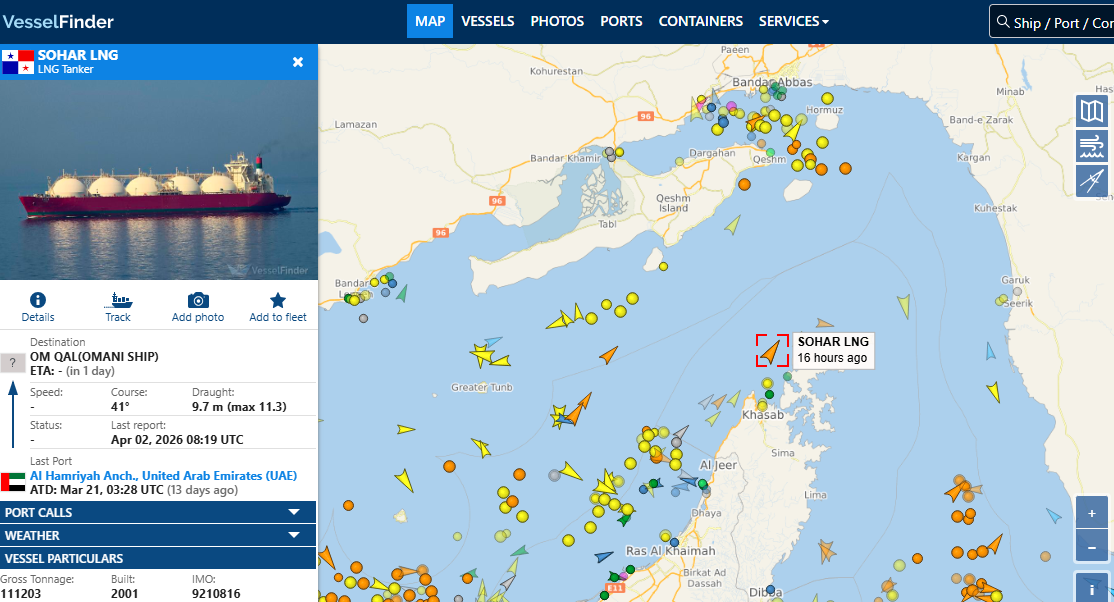
It remains unclear whether the vessel has completed its journey, as crossing the strait typically takes several hours. Additionally, strong signal interference and spoofing activities in the area have complicated efforts to track vessels entering and exiting the Strait of Hormuz.
Since the outbreak of the US-Iran conflict on February 28, LNG carriers have avoided passing through the Strait of Hormuz. Data from the vessel tracking site TankerTracker shows that no LNG carriers were observed traversing the Strait of Hormuz throughout March.
Approximately 20% of the world's liquefied natural gas supply typically passes through this waterway. Due to the reduction in fuel supply, natural gas prices in Europe and Asia have surged over the past month.
Are vessels attempting to navigate the 'southern route' of the strait?
Analysts also pointed out that more importantly, the 'Sohar' vessel appears to be traversing the 'southern route' of the strait (close to Oman's coastline), which is highly unusual — as ships typically take the 'northern route' at Iran’s request, passing through the channel between Iran's Larak Island and Qeshm Island. In other words, this Omani vessel seems to be making a 'risky breakout'.
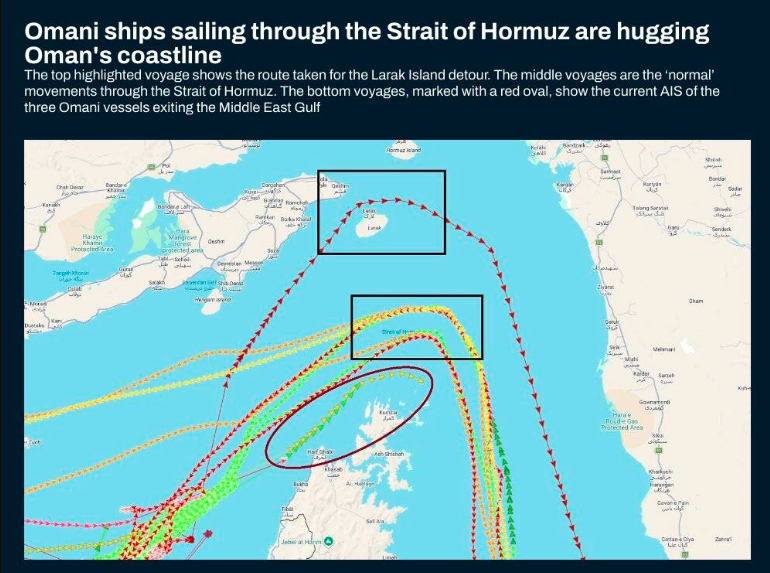
Moreover, the 'Sohar' is not traveling alone. According to data from Lloyd's List and Hormuz Letter, two additional very large crude carriers (VLCCs) are also navigating through the Strait of Hormuz, closely hugging Oman's coastline. Unlike the empty 'Sohar', these two vessels are loaded with approximately 4 million barrels of cargo from Saudi Arabia and the UAE.
Tracking data shows that each tanker carries about 2 million barrels of crude oil. One tanker loaded in late February in Saudi Arabia, with its destination shown as Kyaukpyu Port in Myanmar, where an oil pipeline transports crude to western China. The other tanker is transporting crude from Abu Dhabi to an undisclosed destination.
Over the past few weeks, vessels crossing the 'northern route' of the Strait of Hormuz in the Gulf region have often been related to Iran's demands for approval to pass through the strait and payment of transit fees. However, this route has shallow waters and a smaller turning radius, which may not be suitable for the largest tankers.
Notably, the attempts by the aforementioned vessels to navigate the strait coincide with reports on Thursday from Iranian state media regarding a planned agreement. Iran and Oman are drafting an agreement aimed at implementing 'transit supervision' for vessel traffic passing through the Strait of Hormuz.
According to reports, Kazem Garibabadi, Iran's Deputy Minister of Foreign Affairs responsible for legal and international affairs, stated that tanker transportation through this critical channel 'should be conducted under the supervision and coordination of Iran and Oman.' Garibabadi said, 'Of course, these requirements do not mean restricting passage but aim to facilitate navigation, ensure safety, and provide higher-quality services for passing vessels.'
The joint establishment of a strait passage mechanism by Iran and Oman is not sudden. According to CCTV News, Omani Foreign Minister Badr recently posted on social media that Oman is accelerating relevant efforts to promote the establishment of a secure passage mechanism for the Strait of Hormuz.
Editor /rice