
The premium of the WTI crude oil near-month contract over the next-month contract exceeded $13, marking the largest spread since 1983. TD Securities warned that up to 600 million barrels of crude oil could face losses by the end of this month. The spot Brent crude price surged to $141, the highest level since 2008. Analysts commented: Trump's speech on Thursday was a disaster.
After U.S. President Trump vowed to continue bombing Iran for several weeks, the nearest-month crude oil contract in the U.S. recorded the largest premium relative to the next-month contract on Thursday in history.
The price of the May WTI crude oil contract rose more than 11%, closing at $111.54 per barrel, over $13 higher than the June contract price of $98.04 per barrel. This marks the largest spread between the nearest-month and next-month contracts since records began in 1983.
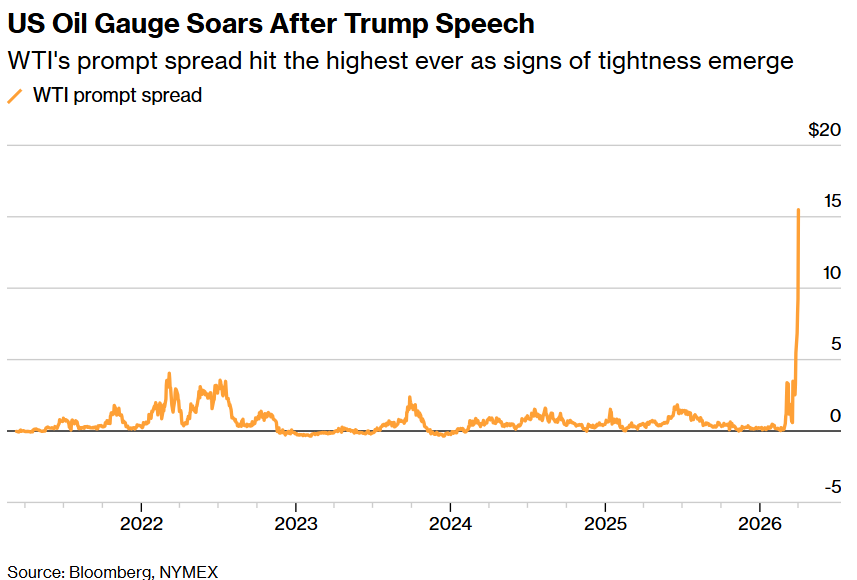
 Before Trump's national address on the war, U.S. crude oil prices fell 1.24% on Wednesday, closing at $100.12 per barrel. Bob McNally, president of Rapidan Energy Group, stated that Trump’s previous remarks about the war potentially ending soon had been quite effective in lowering oil prices, as the market previously believed 'this nightmare could not last.' However, during Trump’s speech, as it became clear the war would not end in the short term, oil prices started to rise.
“I suspect there were many short sellers who bet that Trump would announce some form of ceasefire, and they covered their positions near the close,” McNally said. “This speech was bullish, so we are now seeing some short covering in the May contract at settlement.”
Also on Thursday, according to data tracked by S&P Global, the spot price of prompt physical Brent crude surged to $141.36 per barrel, the highest level since the 2008 financial crisis.
Spot prices reflect demand for Brent crude scheduled for delivery within the next 10 to 30 days. The elevated prices for near-term delivery indicate significant supply disruptions caused by Iran’s closure of the Strait of Hormuz, leading to tight physical supplies currently.
Trump's Speech on Iran War Paints Bleak Outlook for Oil Market, with Over 600 Million Barrels of Crude at Risk
Traders are preparing for a prolonged conflict—a conflict that will exacerbate already severe global energy supply disruptions.
“With the conflict now expected to last at least until late April, calculations tied to crude oil-related data are becoming increasingly grim,” Ryan McKay, senior commodity strategist at TD Securities, said in a note to clients on Thursday.
McKay noted that by the end of this month, nearly one billion barrels of oil will be lost, including up to 600 million barrels of crude and approximately 350 million barrels of refined products like jet fuel, diesel, and gasoline. He added that each additional month of the war would result in a further loss totaling 450 million barrels.
Rapidan Energy Group forecasts that by the end of June, the total net loss of crude oil and refined products will reach 630 million barrels when considering rerouting pipelines, releasing emergency reserves, and drawing down inventories.
Tom Kloza, an independent oil analyst, stated that physical crude buyers in Houston, U.S., are currently willing to pay nearly $120 per barrel, or a premium of approximately $5.50 over the May futures contract.
"This speech by Trump was a disaster," John Kilduff, founding partner of Again Capital, told CNBC. He noted that the market is quickly pricing in the implications of a prolonged conflict and the closure of the Strait of Hormuz.
Trump did not outline plans for the U.S. to reopen this vital maritime route in his speech. He threatened to bomb Iran’s power plants and revert the country "to the Stone Age." He advised nations affected by the strait's closure to purchase oil from the U.S.
"I can't believe the U.S. military didn’t start degrading the Strait of Hormuz interception capabilities on day one of the conflict," McNally told CNBC. "It’s like you wouldn’t imagine a skydiver jumping out of a plane without a parachute."
Matthew Bernstein, an analyst at Rystad Energy, said the market is beginning to price in the long-term impacts of the war. "Looking ahead, nothing will return to pre-war conditions. Even after the war ends, oil prices will be supported by new stockpiling demand, higher insurance premiums and freight costs associated with the Strait of Hormuz, and a broader geopolitical risk premium in the market."
TD Securities’ McKee said that with the strait still closed, oil inventories will begin to face pressure. Oil stored on tankers will be rapidly depleted, and onshore inventories could drop to multi-year lows as early as August.
"As the market’s inventory buffer erodes, the physical tightness seen so far in Asia will begin to spread globally," he said, adding that crude and refined product prices "will face increasing upward pressure in the coming weeks and months" until high prices start to suppress demand.
Shell CEO Wael Sawan warned last week in Houston that fuel shortages would create a ripple effect globally, starting with aviation fuel, followed by diesel, and finally gasoline.
"It’s a ripple effect," Sawan said at the S&P Global Energy Week conference held on March 24. "We are certainly seeing South Asia bear the brunt initially. As we move into April, the impact has spread to Southeast Asia, Northeast Asia, and then more into Europe."
Natasha Kaneva, head of global commodities research at JPMorgan, stated in a report to clients on March 26 that the United States is largely unaffected by shortages due to robust domestic production. However, Kaneva noted that the West Coast, particularly California, may face supply disruptions in May due to reliance on imports.
Patrick De Haan, head of petroleum analysis at GasBuddy, posted on social media that at the current rate, U.S. retail gasoline prices could surge to between $4.25 and $4.45 per gallon within the next two weeks. Diesel prices could rise to between $5.80 and $6.05 per gallon.
De Haan stated that record-high gasoline prices might not be far off. In June 2022, U.S. gasoline prices reached an all-time high of $5.02 per gallon.
Crozat stated that the spike in diesel prices is currently the most serious issue. 'This could trigger significant inflation in the second quarter.'
Editor/Doris