
① Analysts expect Samsung Electronics' operating profit for the first quarter to reach 40.5 trillion Korean won, close to last year's annual level; ② The "memory super cycle" enters the earnings verification window. Despite the ongoing trend of DRAM shortages and price increases, the loosening of spot prices, the impact of Google’s compression algorithms, coupled with rising risks of union strikes, have caused significant market divergence.
Cailian Press, April 3 (Editor Shi Zhengzhi) After more than half a year of global capital market hype around the "memory super cycle," it will turn into concrete financial figures next week.
According to the consensus analyst earnings forecast from LSEG, Samsung Electronics, which is set to release its earnings report next Tuesday, is expected to record an operating profit of 40.5 trillion Korean won (approximately $269 billion, or RMB 182.7 billion) for January to March this year. Some analysts are even more optimistic, with Citi providing an estimate as high as 51 trillion Korean won.
 In comparison, this largest memory chip producer globally reported a total operating profit of 43.6 trillion Korean won last year, ranking fourth-highest in the company’s history, only behind 2018 (58.89 trillion Korean won), 2017 (53.65 trillion Korean won), and 2021 (51.63 trillion Korean won).
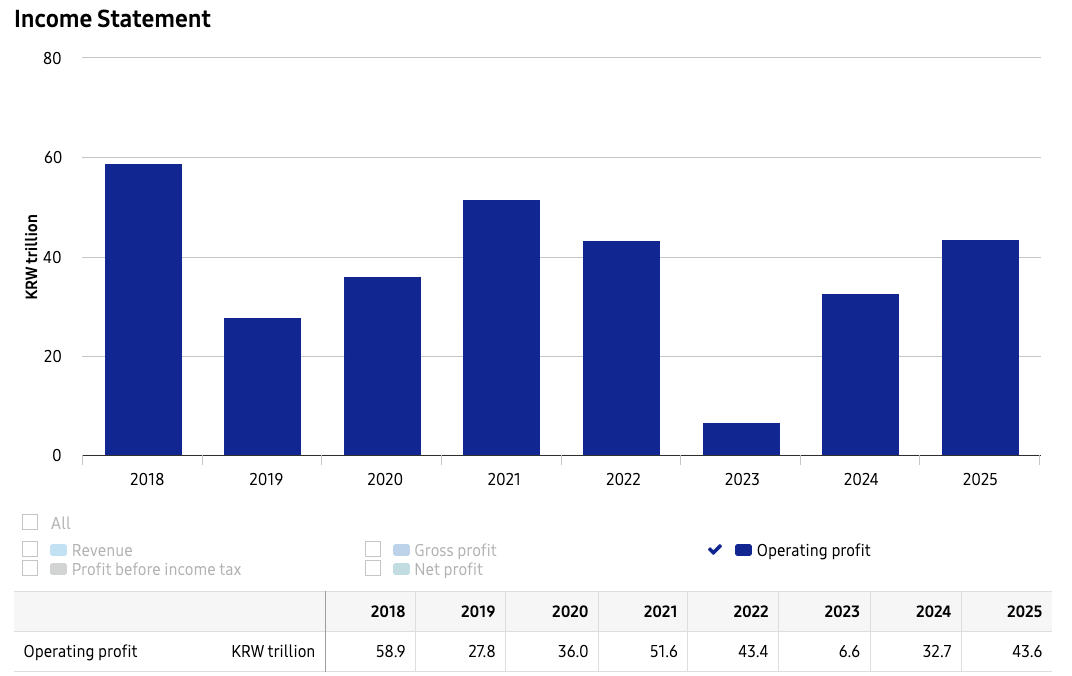
(Samsung Electronics' fiscal-year operating profit; source: company website)
In the context of this year’s market environment, the operating profit for the first half of the year (more precisely, the first four and a half months) would be sufficient to set a new record for Korea’s conglomerates’ annual operating profits.
It is worth noting that Samsung Electronics will only disclose operating data next week, while specific details and the analyst conference call will be held at the end of the month.
As the US-Israel-Iran war enters its second month, the supply of some key raw materials for semiconductor production is under threat. Meanwhile, with products such as smartphones and computers increasing in price due to memory cost pressures, DRAM spot prices have shown some signs of easing recently. Coupled with Google’s TurboQuant memory compression algorithm released last month, it has triggered a collective pullback in storage chip stocks.
Since the outbreak of the war on February 28, Samsung Electronics, whose stock price quadrupled over the past year, has already dropped nearly 14% from its peak.
Some institutions pointed out that the shortage of memory chips remains severe, and this round of price increases has yet to end.
Toby Gnaumann, President of semiconductor distributor Fusion Worldwide, noted that there has indeed been a cooling in spot prices for memory chips over the past three to four weeks; however, he believes this is temporary. He argues that current demand and backlog orders remain robust, and it will take a considerable amount of time before memory manufacturing can fully meet overall demand.
Market research firm Trendforce also forecasts that DRAM chip prices under traditional contracts will continue to rise significantly. The price of these chips doubled in the first quarter compared to the previous quarter, and Trendforce predicts an additional increase of 58% to 63% between April and June.
At its March shareholders' meeting, Samsung Electronics stated that the company is collaborating with key clients to shift towards contracts lasting three to five years to protect itself from demand fluctuations.
Although its storage business is unlikely to underperform, other divisions within Samsung are facing challenges.
Korea Yuanta Securities estimates that profits from Samsung's smartphone and LCD panel divisions may decline by approximately half in the first quarter due to rising memory costs and fierce competition. Samsung's foundry business, which competes with Taiwan Semiconductor, is expected to remain in a loss-making state. Recently, this division reached a collaboration with NVIDIA to jointly manufacture new artificial intelligence inference chips.
Meanwhile, Samsung is also facing pressure from labor unions demanding changes to the bonus system. If an agreement cannot be reached, the union may initiate a strike as early as May.
Editor/Jayden