
Anthropic stated that the 'Lobster' OpenClaw remains accessible through additional usage packages (currently discounted) or the Claude API key. Affected users will receive compensatory credits and can apply for refunds. Analysts believe this adjustment signifies a shift in Anthropic's business model towards usage-based billing, potentially reflecting a strategic consideration to guide users toward proprietary products.
Anthropic announced adjustments to its subscription policy, separating the usage costs of third-party AI tools from subscription packages. This move effectively significantly raised the threshold for users to access Claude through tools like OpenClaw.
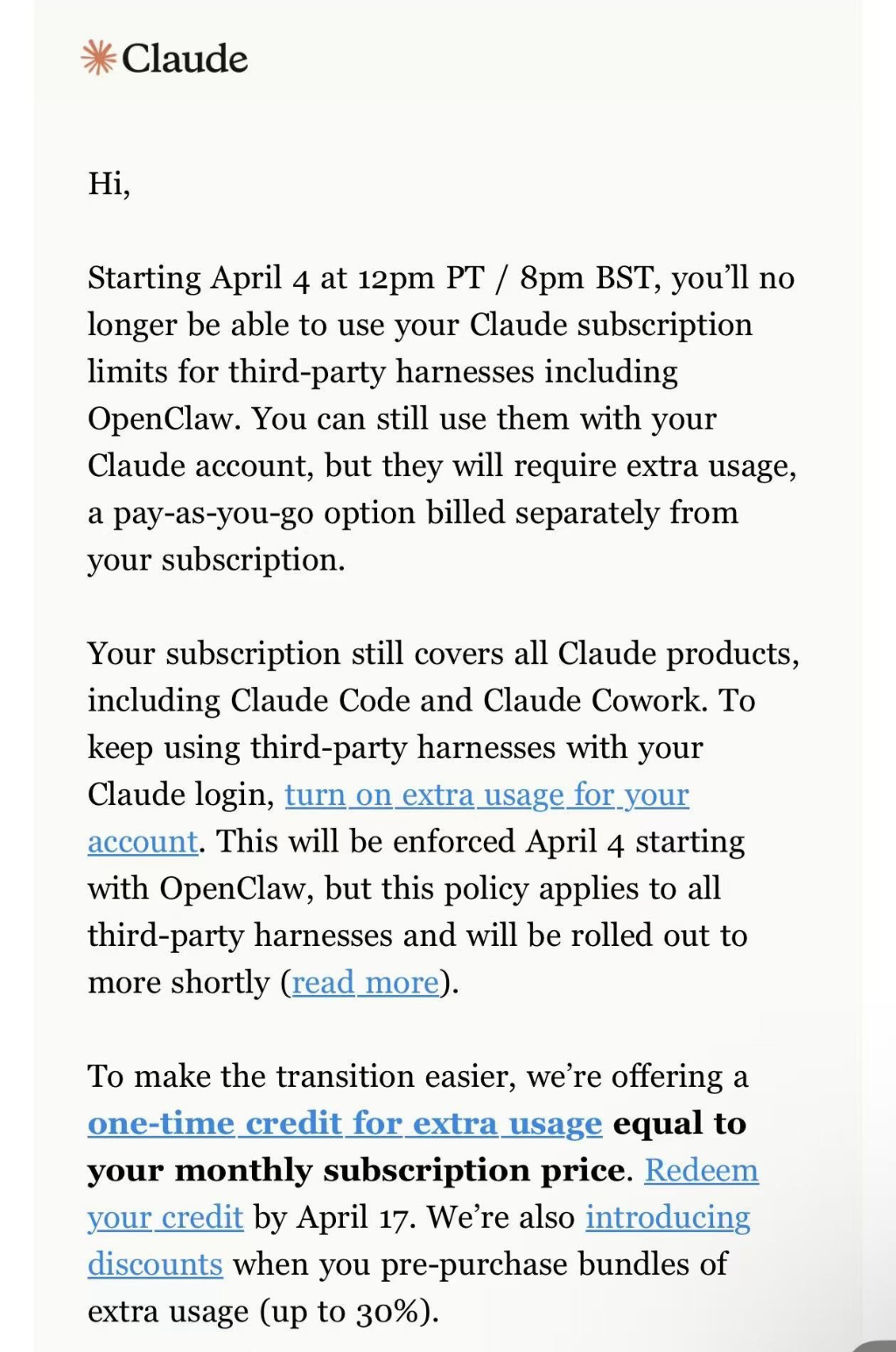
On Friday evening Eastern Time, according to an email sent by Anthropic to its users, starting from 3:00 PM local time on April 4, Claude subscription credits will no longer cover the use of third-party tools such as OpenClaw.
 Users wishing to continue accessing Claude through OpenClaw can still do so via Claude login, but must use these tools through additional usage packages (currently discounted) or a Claude API key.
This policy change came unexpectedly. Peter Steinberger, founder of OpenClaw, revealed that he and Dave Morin, a member of OpenClaw’s board, had attempted to communicate with Anthropic.
The only concession they managed to secure was a one-week delay in implementation.
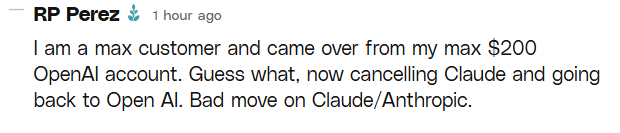
Some netizens expressed dissatisfaction, stating:
I was a premium member of Claude, and previously used OpenAI's $200 advanced account. Guess what? I've now canceled my Claude subscription and plan to switch back to OpenAI. Choosing Claude/Anthropic was a terrible decision.
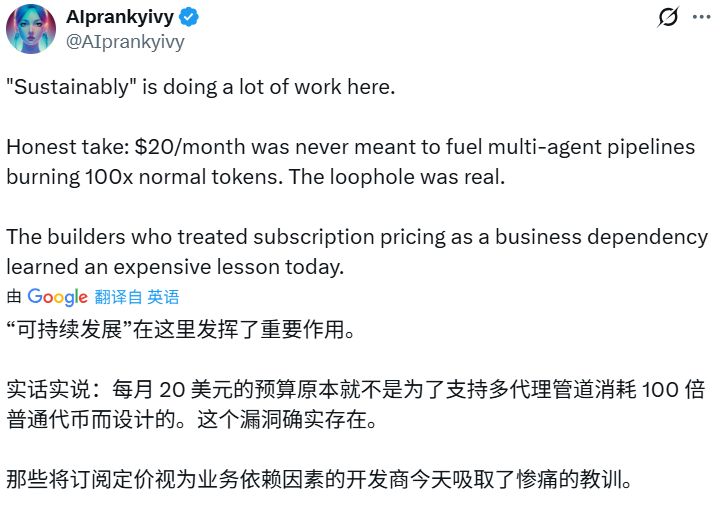
However, some netizens voiced support, arguing that the Claude membership package was never intended for running AI agents consuming resources at 100 times the normal level.
The term 'Sustainably' carries significant implications here. Let’s be honest: the $20 monthly subscription fee was never meant to support running 'multi-agent' systems consuming resources at 100 times the normal level. That loophole did exist.
Demand Management and Sustainable Growth
Boris Cherny, executive of Anthropic Claude Code, explained the rationale behind the adjustment:
We have been striving to meet the growing demand for Claude, but our subscription model was not designed for the usage patterns of these third-party tools. Capacity is a resource we need to manage carefully, and we are prioritizing customers who use our proprietary products and APIs.
Cherny stated on social media:
Affected users will receive a one-time compensation in the form of credits equivalent to their monthly subscription fee. For additional usage, discounted packages can be purchased; for a full refund, users may submit a request via the link provided in the email sent the following day.

Users of third-party tools may continue using related functionalities through the Claude API key but will bear the associated costs independently.
“Lobster” OpenClaw gained rapid popularity earlier this year. This AI agent efficiently handles tasks such as inbox management, calendar scheduling, and even flight check-ins, amassing a large base of active users.
However, this intensive usage pattern has evidently placed significant pressure on Anthropic’s infrastructure, ultimately prompting this policy tightening.
Notably, Peter Steinberger, founder of OpenClaw, has now joined OpenAI.
Against this backdrop, analysts suggest that Anthropic’s adjustments may also reflect another consideration: guiding subscribers toward its proprietary collaboration tool, Claude Cowork, to reduce reliance on third-party ecosystems with competitive ties.
Business model shift: Monetization opportunities beyond subscriptions
This policy adjustment marks a clear shift in Anthropic's business model for end consumers.
By separating high-frequency, non-standard usage scenarios from fixed subscriptions and transitioning to a pay-per-use model, Anthropic is able to secure revenue proportional to resource consumption from high-usage customers while safeguarding the core user experience.
The introduction of discounted usage packages indicates that Anthropic does not intend to completely alienate third-party tool users but instead seeks to strike a balance between capacity management and retaining paying customers.
However, for OpenClaw users accustomed to subscription-based unified billing, the increase in usage costs will remain an unavoidable reality.
Editor/Melody