A leaked document reportedly revealed that OpenAI's valuation in this round reached 852 billion US dollars. Microsoft’s 13 billion US dollar investment has surged to approximately 228.3 billion US dollars, yielding over 17 times return. SoftBank's 64.6 billion US dollar investment is currently valued at around 99.3 billion US dollars. NVIDIA’s return remains roughly flat. CEO Sam Altman still holds no equity stake to date.
A purportedly leaked OpenAI capitalization table has, for the first time, laid bare the internal profit-sharing structure of this AI company to the public.
Recently, a document claimed to be OpenAI's capitalization table (cap table) has been widely circulated online. According to a report by Celebrity Net Worth on April 3, the document was exposed almost simultaneously with news of OpenAI’s latest funding round — OpenAI had just completed a $122 billion financing round, valuing the company at $852 billion. The report stated that the document “appears to be authentic.”
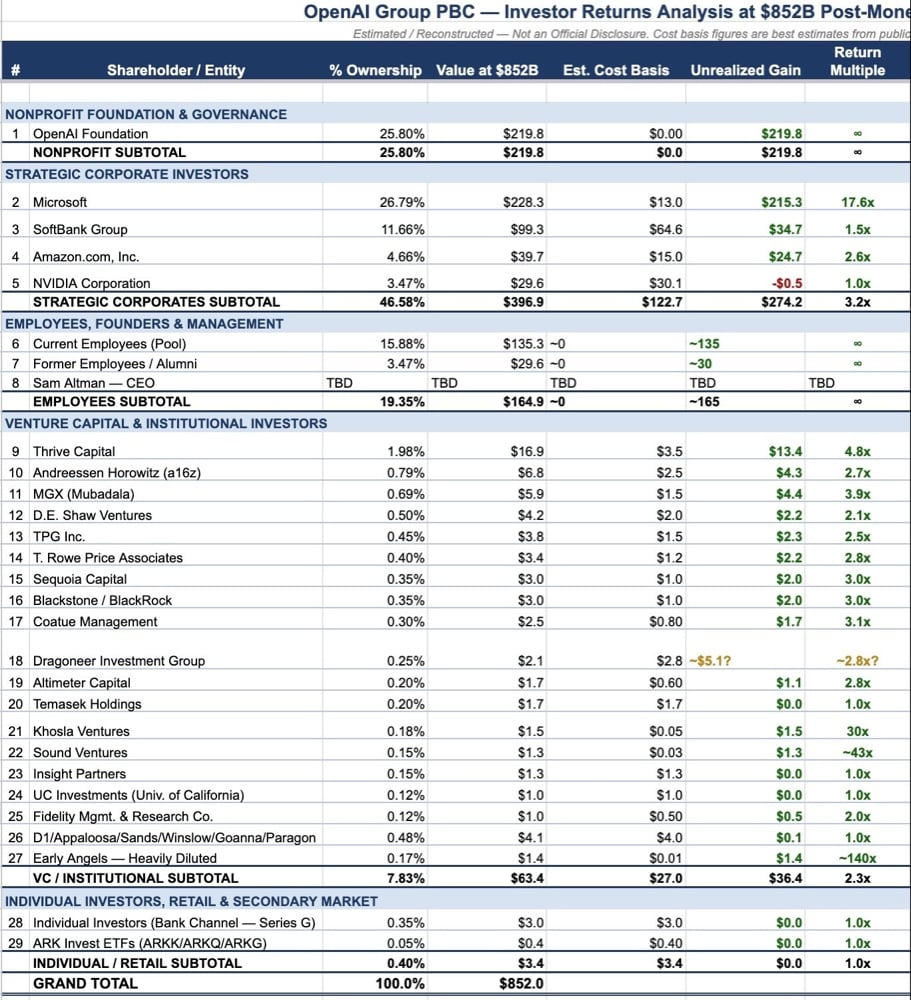
 According to the document, the top five shareholders of OpenAI are as follows:$Microsoft (MSFT.US)$(26.79%), OpenAI Foundation (25.8%),$SoftBank Group (ADR) (SFTBY.US)$(11.66%)、$Amazon (AMZN.US)$(4.66%) and$NVIDIA (NVDA.US)$(3.47%). Current and former employees collectively hold approximately 20% of the shares.
$Microsoft (MSFT.US)$The "$13 billion investment" has risen to "$228.3 billion",$SoftBank Group (ADR) (SFTBY.US)$with $64 billion invested now valued at approximately $99.3 billion.
The most striking detail: CEO Sam Altman still holds no equity in the company according to the capitalization table.
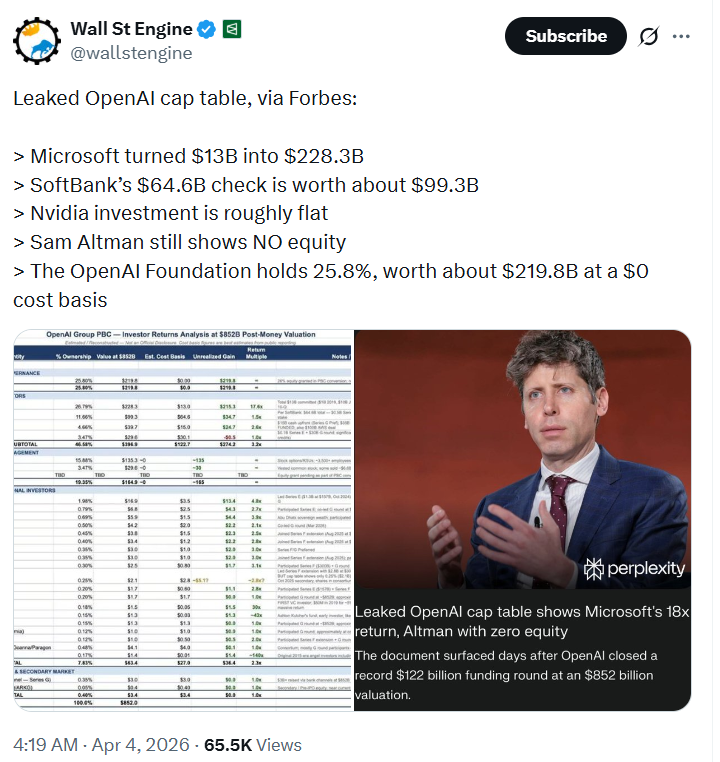
Microsoft sees the highest returns, followed by SoftBank, while NVIDIA experiences a slight loss.
In terms of return on investment,$Microsoft (MSFT.US)$is the biggest winner on this equity table.
According to Wall St Engine’s reference to Forbes data on the X platform, Microsoft has cumulatively invested approximately $13 billion. Based on the current valuation of $852 billion, its stake is worth about $228.3 billion, generating a return exceeding 17 times the initial investment.
$Microsoft (MSFT.US)$is the largest single shareholder of OpenAI. CEO Nadella's total investment commitment is approximately $13 billion, to be injected in multiple tranches. This includes $1 billion in 2019, $10 billion in January 2023 (confirmed in Microsoft’s 10-Q report), and an additional $2 billion in 2024.
led by Masayoshi Son.$SoftBank Group (ADR) (SFTBY.US)$Holding an 11.66% stake in OpenAI, valued at $99.3 billion. The investment cost was $64.6 billion, making it the largest single investment outside of Microsoft shareholders. The return on investment is 1.5 times.
SoftBank Group's portfolio composition is relatively complex. Approximately $500 million stems from Series E funding, $300 billion from the large-scale Series F funding, and about $340 billion from Series G funding. Masayoshi Son once referred to OpenAI as 'the most important company on Earth.'
$NVIDIA (NVDA.US)$The return on investment showed a "slight loss." NVIDIA holds a 3.47% stake in OpenAI, valued at $29.6 billion, while the cost was $30.1 billion.
The OpenAI Foundation holds 25.8% of shares, with an estimated value of approximately $219.8 billion and zero cost. Analysts note that the foundation’s 25.80% stake represents the largest unencumbered asset on the equity structure table. It cannot be sold or leveraged for financing. Theoretically, its existence ensures that artificial general intelligence (AGI) benefits all humanity.
Sam Altman currently holds no equity; the IPO may serve as a turning point.
Another widely noted detail in the equity table is that Sam Altman does not own any shares in OpenAI.
Celebrity Net Worth posed the direct question: 'Otherwise, what is he doing here?' and pointed out that this situation will 'almost certainly change' once OpenAI goes public.
OpenAI is reportedly planning an initial public offering this year or early next year with a market valuation of $1 trillion.
Ashton Kutcher: $30 million turned into $1.3 billion.
Line 22 of the equity table reveals a highly discussed name: Sound Ventures.
This venture capital firm holds a 0.15% stake in OpenAI, with an investment cost of approximately $30 million. Based on the current valuation, this translates to roughly $1.3 billion, representing a return multiple of about 43 times.
One of the co-founders of Sound Ventures is Hollywood actor Ashton Kutcher.
It should be noted that the $1.3 billion does not entirely belong to Kutcher personally. Sound Ventures is a fund with a profit-sharing structure involving external LPs (Limited Partners) and GPs (General Partners).
According to Celebrity Net Worth, if we conservatively estimate Kutcher's actual exposure to this investment at around 30%, his personal stake amounts to approximately $400 million. Including other assets, the media estimates Kutcher’s current net worth at about $600 million. If OpenAI goes public at a valuation of $1 trillion, the value of his holdings would further increase to approximately $470 million.
Sound Ventures acquired its stake in OpenAI when the company was valued between $20 billion and $29 billion, during the early stages of the 2023 AI boom.

In May 2023, Sound Ventures announced the completion of a $240 million fund focused on AI, which was oversubscribed.
Kutcher’s assessment at the time was: "Artificial intelligence will be the most important technological transformation since the internet."
The fund subsequently deployed capital into several AI infrastructure companies, including Anthropic, StabilityAI, and OpenAI.
Celebrity Net Worth pointed out that if other bets, such as Anthropic, also follow OpenAI’s trajectory, the returns Kutcher could gain from this fund "might easily increase by several hundred million dollars more."
Editor/Melody