①As countries negotiate with Iran to ensure the passage of their vessels, an increasing number of ships are crossing the strait, including those without clear ties to Iran; ②On Friday, a French container ship and a liquefied petroleum gas (LPG) vessel owned by a Japanese-affiliated company passed through the Strait of Hormuz. This appears to be the first such passage since this critical waterway was blocked due to the US-Iran war.
According to industry-compiled vessel tracking data, the number of ships passing through the Strait of Hormuz has rebounded over the past week. The seven-day rolling average of daily transits as of Friday reached its highest level since the outbreak of the US-Iran conflict at the end of February.
As countries negotiate with Iran to ensure the passage of their vessels, an increasing number of ships are crossing the strait, including those without clear ties to Iran. On Friday, a French container ship and a liquefied petroleum gas (LPG) vessel owned by a Japanese-affiliated company passed through the Strait of Hormuz. This appears to be the first such passage since this critical waterway was blocked due to the US-Iran war.
 Data shows that from Friday morning local time to Saturday evening, a total of 13 ships passed through the strait, with 10 exiting the Persian Gulf and three entering from international waters.
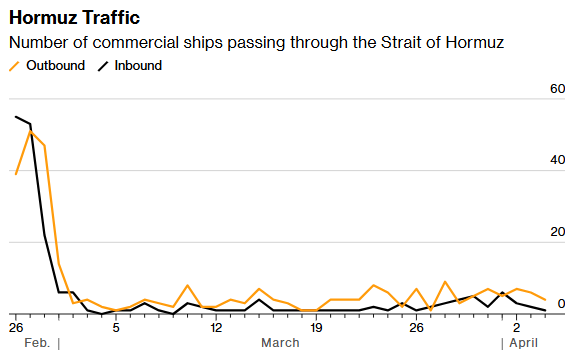
While the resumption of navigation through the strait is encouraging, compared to the levels prior to the outbreak of the war on February 28, it remains just a trickle. In normal times, about one-fifth of the world's oil and liquefied natural gas passes through the Strait of Hormuz every day.
Iran has taken steps to strengthen its control over this waterway, establishing a toll system and directing most vessels to follow specific routes near its borders. Over the past day, all recorded transit vessels have passed through the narrow 'northern route' of the strait located between Larak Island and Qeshm Island.
The latest transits include a French container ship and an LPG tanker owned by a Japanese entity. This appears to be the first such passage since the start of the war. It remains unclear whether these voyages were the result of diplomatic efforts or negotiations by shipping companies and their intermediaries.
According to two informed sources, the French container ship named CMA CGM Kribi exited the strait on Friday. This is the first known vessel associated with Western Europe to pass through the strait since the outbreak of the war more than a month ago. Before entering Iranian waters, the French vessel changed its Automatic Identification System (AIS) destination information to 'Shipowner France,' signaling its nationality to Iranian authorities.
On the same day, French President Emmanuel Macron stated that only diplomatic efforts, not military actions, could reopen the Strait of Hormuz.
Mitsui O.S.K. Lines of Japan also confirmed on Friday that an LPG tanker operated by its affiliate had passed through the Strait of Hormuz by April 4 Japan time. This is reported to be the second Japan-related vessel to exit the Gulf since the de facto blockade of the Strait of Hormuz and the first Japanese LPG tanker to do so.
Turkey also stated late on Friday that a Turkish vessel had recently departed from the strait.
Iran's 'new passage mechanism' is emerging.
Prior to this, most vessels passing through the Strait of Hormuz were from Iran or countries friendly with Iran. Some countries, such as Pakistan, have negotiated bilateral agreements with Iran regarding safe transit, and most ships have been observed traveling along the 'northern route' of the strait close to Iran’s coastline. However, some intriguing changes in shipping conditions in the Strait of Hormuz have emerged recently.
Some ships have since opened up another route—along Oman’s coastline. As reported by Cailian News on Friday, three vessels appeared to be crossing the 'southern route' of the Strait of Hormuz at that time.
Meanwhile, Iran is taking steps to consolidate its long-term control over the strait, initiating efforts to establish a toll system for this waterway critical to global oil and gas supplies. This has shocked the Gulf Arab states that rely on the waterway for exports. Iran has indicated it could jointly manage a new system with Oman, though Oman has yet to make any official statement.
According to informed sources, Iran has established a tiered mechanism for passage through the strait, divided into five levels. Countries with closer ties to Iran are more likely to receive preferential terms. This emerging system requires ship operators to contact intermediaries linked to Iran’s Islamic Revolutionary Guard Corps, providing sensitive data including details of vessel ownership, crew lists, and Automatic Identification System (AIS) data.
The joint establishment of a strait passage mechanism by Iran and Oman is not sudden. According to CCTV News, Omani Foreign Minister Badr recently posted on social media that Oman is accelerating relevant efforts to promote the establishment of a secure passage mechanism for the Strait of Hormuz.
Editor/Lambor