Source: Tencent Technology
On the issue of semiconductor export controls—from EUV lithography machines to advanced DUV lithography systems and H100 chips—Silicon Valley has split into two camps.
Jensen Huang, Lisa Su, and others have long advocated for deregulation, arguing that excessive regulation effectively cedes the market to competitors, while Anthropic CEO Dario Amodei is a staunch proponent of regulation, once comparing advanced chips to nuclear weapons.
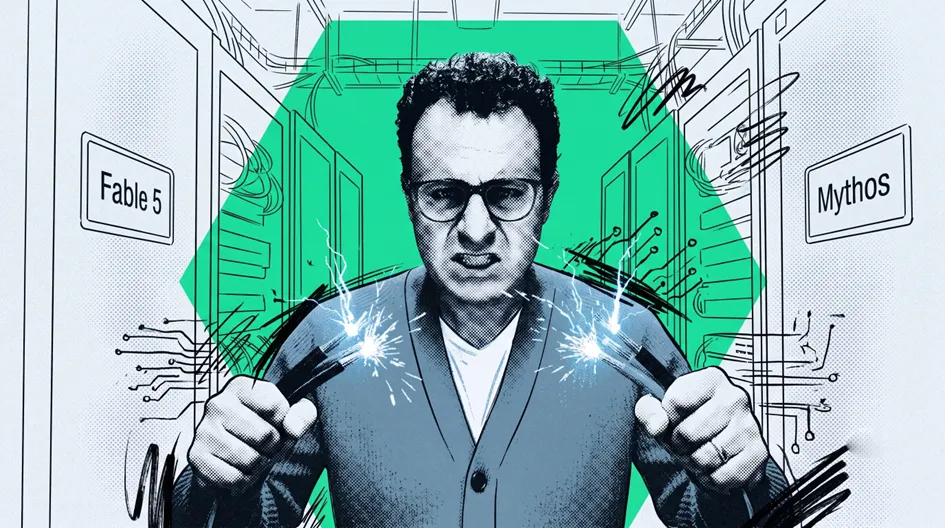
 Jensen Huang has repeatedly made veiled criticisms of Amodei, accusing him of having a 'God complex.' 'It’s madness to equate AI with nuclear weapons or uranium enrichment. We’re not enriching uranium—we’re just making a small chip,' Huang said on the Dwarkesh Patel podcast.
Amodei, a self-proclaimed 'true believer' in stringent regulation, likely never anticipated that his own calls for strong oversight would one day be turned against Anthropic—Mythos and Fable 5, two frontier models, have been barred by the U.S. government from serving any 'foreign nationals' globally.
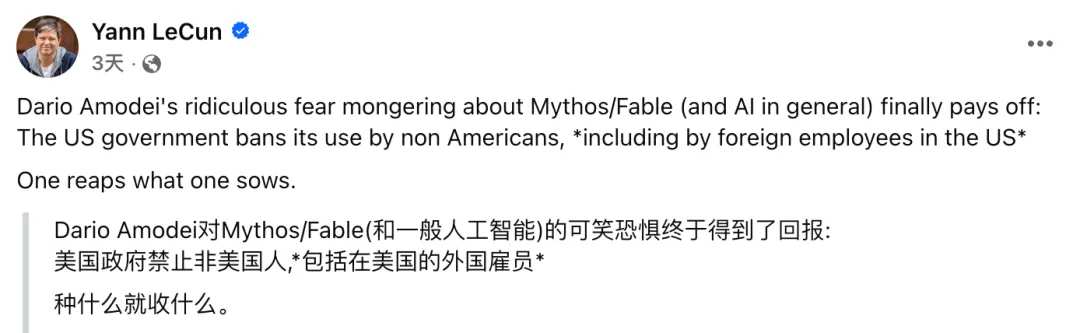
“Amodei’s absurd fear-mongering about Mythos/Fable—and indeed the entire AI field—has finally paid off: the U.S. government has banned non-U.S. persons from using it, even including foreign employees working legally within the United States. You reap what you sow,” wrote Turing Award winner Yann LeCun on Facebook.
The Chinese idiom 'you reap what you sow' is colloquially rendered in this context as 'ask for a hammer and get hit by one.' Later, in the comments section, LeCun further mocked Amodei, suggesting he might exploit the restrictions to boast about how powerful his models must be.
According to signals from certain U.S. policy circles, the restrictions targeting the Mythos and Fable models will not last long. David Sacks, White House AI advisor often dubbed the 'AI czar,' stated the ban is only temporary and expressed hope that Anthropic would swiftly patch its security vulnerabilities.
At this juncture, we aim through this article to clarify the origins and developments of the 'model ban,' its core controversies and underlying issues, the likelihood of long-term export controls, and the potential implications for Anthropic and the broader artificial intelligence industry.
01. “72-Hour Crisis”
Many American films favor titles referencing “hours” to emphasize dramatic changes within a short timeframe. Anthropic’s new model, from launch to removal—such as Fable 5—lasted only 72 hours, fitting neatly into this narrative framework.
On June 9, Anthropic launched its most powerful models since inception: Claude Fable 5 and Claude Mythos 5—the company’s first “Mythos-class” models. Fable 5 is the publicly available version, equipped with a safety classifier that automatically routes queries in high-sensitivity domains such as cybersecurity, biology, and chemistry to the less capable Opus 4.8. Mythos 5 is built on the same underlying model but with safety restrictions removed, offered exclusively through Project Glasswing to approximately 150 vetted organizations.
At that point, two months had already passed since the first preview of Mythos was unveiled.
In its official blog post, Anthropic stated, “The Fable 5 series features the strictest safety protections among all models tested.”
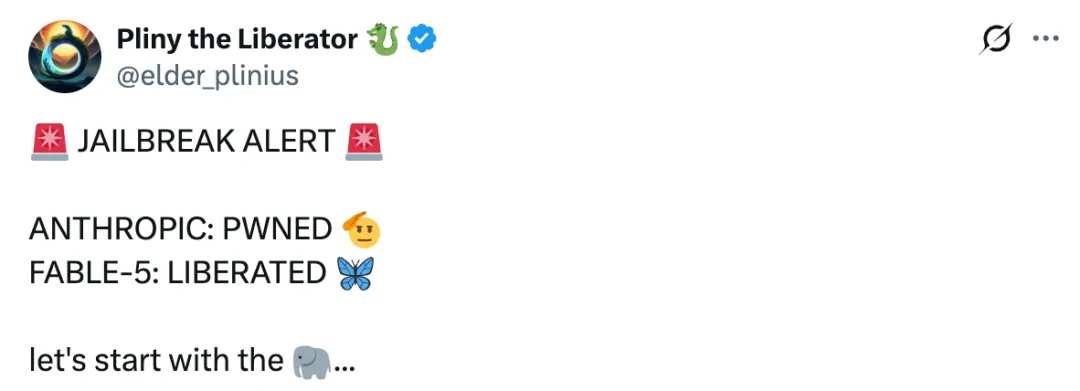
Just one day later, renowned AI jailbreaker Pliny the Liberator posted an all-caps message on X: “JAILBREAK ALERT, ANTHROPIC PWNED, FABLE-5 LIBERATED.” He claimed to have bypassed Fable 5’s safety classifier using techniques including Unicode substitution, homoglyphs, long-context dilution, and decomposition-reassembly methods.
At the time, Amodei might still have been basking in the euphoria over Fable 5’s seemingly unparalleled capabilities and had not yet noticed the risk flagged by Pliny. He published a lengthy article on his personal blog titled “Policy Responses to Exponential Growth in Artificial Intelligence,” arguing that governments should have the authority to block the deployment of unsafe AI models.
Like Pliny,$Amazon (AMZN.US)$researchers also identified the model’s “jailbreak” vulnerability, though their approach to addressing it differed slightly.
Amazon CEO Andy Jassy bypassed Anthropic—the company Amazon has heavily invested in—and directly delivered a 'jailbreak' report to the White House and the U.S. Department of Commerce.
Multiple foreign media outlets reported that on the day after receiving Amazon’s whistleblower letter (June 12), Anthropic received an ultimatum from the U.S. government, ordering it to disable access to two of its models within 90 minutes. Amodei attempted to intervene with a phone call but ultimately received an 'emergency export control order.'
On the evening of June 12, Anthropic complied with the order. Interestingly, Amodei and his team went beyond the requirement, cutting off global access to Fable 5 and Mythos 5—effectively imposing a blanket shutdown regardless of whether users were American or not.
From its launch on June 9 to its emergency takedown on June 12, Anthropic endured what could be called its '72 Hours of Crisis.'
When I reposted this news on my social feed, I quoted a classic line from a Hong Kong film: 'If it’s too hard to handle, then nobody gets to handle it.'
This raises a point worth exploring: the directive specifically required cutting off access for 'non-U.S. persons,' so why did Anthropic opt for such a sweeping, indiscriminate approach? After all, Anthropic has never been a 'compliant child.' In Q1, Amodei explicitly rolled out the company’s own 'Constitutional AI' terms of service, signaling a willingness to forgo U.S. government contracts to uphold the principle that 'AI must not be used for military or surveillance purposes.'
Regarding the 'blanket cutoff' approach, some analysts argue that Anthropic lacked sufficient time to implement user filtering, especially since many users accessed the models via APIs—including intermediary or proxy APIs—making technical implementation extremely challenging.
This explanation is plausible, yet a review of Anthropic’s policy pages reveals the company had already been preparing for such scenarios. Its recently updated privacy policy explicitly hints at requiring users to submit personal information such as age and identity—a move widely interpreted as a precursor to potential 'facial recognition' integration in future Claude models. From this perspective, identifying whether a user is a 'U.S. person' or 'non-U.S. person' should not pose a significant technical hurdle.
02. The Irresistible Letter
‘Many people are analyzing the legal basis, but in essence, it leveraged the ‘informed letter’ mechanism,’ said a researcher who has long tracked export control policies.
Within the U.S. export control regime, a letter of notification is a commonly used non-public, rapidly issued administrative enforcement tool employed by the Bureau of Industry and Security (BIS) under the U.S. Department of Commerce. It enables regulators to instruct targeted companies—without amending the Export Administration Regulations (EAR) through formal rulemaking—that exports of specific items or technologies require a license.
At the end of 2023,$NVIDIA (NVDA.US)$NVIDIA launched the China-specific H20 product to circumvent EAR provisions that impose restrictions on GPU computational power and bandwidth. Subsequently, BIS issued letters of notification to companies including NVIDIA and AMD, requiring additional licensing for exports of related AI chips, and used this process as a basis to later update the Export Administration Regulations.
Turning to Anthropic, prior to receiving a letter of notification restricting access by 'non-U.S. persons,' the U.S. government explicitly instructed the company to remove the relevant offering within 90 minutes. As reported by Politico and other international media outlets, multiple rounds of discussions took place involving senior officials, including the U.S. Secretary of the Treasury, the U.S. Secretary of Commerce, and the White House AI policy advisor—but Anthropic rejected the directive.
The stark contrast between initially refusing to take down the service and ultimately implementing a blanket disconnection is difficult to explain solely as an 'engineering impossibility.'
Letters of notification typically serve as precursors to formal export control rules, but the aforementioned researcher believes the EAR will not be updated this time. 'Put simply, they just want to stop Anthropic first.'
He argues that in the context of large model releases, it is essential to clarify precisely what is being controlled—but there is currently no clear answer to this question. 'Is it the model weights, API access, inference services, or some abstract notion of “model capability”?'
Historically, export controls have focused more on physical goods; even when applied to technology, controls ultimately pertained to tangible products. However, once model weights are generated, they can be disseminated across digital spaces, making it extremely difficult to enforce an absolute physical 'embargo.'
Therefore, the assumption that 'they just want to stop Anthropic first' is reasonable. After halting the release, authorities can then deliberate on more appropriate governance and alignment mechanisms. It is precisely based on this assumption that one might further infer that Mythos and Fable will soon return—which also explains why David Sacks, dubbed the 'AI czar,' emphasized that the 'ban' is only a temporary restriction.
Then, why would the U.S. government resort to administrative measures to intervene in the release of a frontier AI model by a single AI laboratory?
The model's 'jailbreak exploit' capability.
In March, during a conversation with Zhou Hongyi, Chairman of 360 Group, he specifically highlighted Anthropic’s capability of 'using models to discover vulnerabilities.' He said, 'Anthropic has solved many previously intractable security problems through AI-powered coding and vulnerability detection. Therefore, I proposed that we should pay attention to AI (security) agents.'
The aforementioned researcher also emphasized that Mythos does not involve generic chatbot capabilities, but rather highly specific functions such as vulnerability discovery, attack path analysis, and offensive cyber capabilities.
03. Security Without Consensus
Anthropic not only opted to 'double down' on enforcing the ban but also issued a public statement.
“To ensure compliance, we must immediately halt all user-accessible implementations,” Anthropic wrote in its statement, adding that this was a misunderstanding. The company believed the U.S. government and third-party reports referred to 'jailbreak' methods that were only applied to a small number of previously known, minor vulnerabilities, all of which appeared relatively simple.
In hindsight, both Arvind Narayanan’s argument in his personal blog—that governments should have the authority to block the deployment of unsafe AI models—and Anthropic’s official blog post defining Fable 5 as the safest model reflect absolute confidence in the security of their own product.
However, Anthropic also included a caveat: 'Currently, no model provider can achieve complete jailbreak-proofing.' This statement, contradictory to claims of absolute security, even carries an element of sophistry.
The gist is: Our model is the safest; regulators should intervene only against unsafe models. Our vulnerabilities are few and limited to known, low-severity issues. We’ve done our utmost to restrict 'jailbreaks,' yet no one can completely eliminate them.
But if a model is touted as the safest, why launch it while knowingly harboring vulnerabilities? Isn’t that deploying a compromised system? And if 'jailbreaks' cannot be absolutely prevented, why call for suppressing other models?
Users familiar with Anthropic should know that the company not only excels in model and product capabilities but also takes an aggressively proactive stance on AI safety and governance—so much so that it seems driven by a sense of mission to become a 'rule-maker for the AI era,' continually reinforcing its 'safety-first' image.
On September 19, 2023, Anthropic released its Responsible Scaling Policy (RSP) 1.0, advocating that stronger models must be accompanied by proportionally stronger safety safeguards—and that more powerful models should not be released until their safety has been demonstrated. The document introduced an AI Safety Level (ASL) classification framework: ASL-1 indicates no meaningful catastrophic risk; ASL-2 shows early warning signs but still no catastrophic risk; ASL-3 signifies a significant increase in the risk of catastrophic misuse, and so on.
‘If the scale of AI development outpaces our ability to adhere to necessary safety protocols, the ASL framework will require us to temporarily pause training of more powerful models,’ Anthropic wrote.
One week before the launch of Fable 5, on June 4, Anthropic published an article titled ‘When AI Self-Shapes,’ calling for a ‘proactive pause’ to mitigate the risks associated with recursive AI self-improvement.
Scarcely had those words been spoken when the Fable 5 series of models was launched.
Looking back at this timeline, the situation appears highly ironic—akin to a top student claiming, ‘I never study for exams,’ while secretly cramming intensely behind the scenes.
If they were genuinely concerned, why release their ‘most powerful model’ immediately after calling for a pause? That’s the first question. Moreover, a preview version of the ‘Mythos-class’ model had already been unveiled two months earlier—if the model’s capabilities were truly so groundbreaking, why didn’t they call for a pause at that time?
While Anthropic appears aggressive in its safety posture, its calls for caution and action seem more aimed at constraining competitors: publicly demanding stricter oversight of unsafe models and urging pauses in frontier model development, while simultaneously continuing its own rapid iteration and advancement.
If Anthropic embodied idealism when it released RSP 1.0 in 2023, by the time it issued RSP 2.2 in 2025, it had clearly turned realist.
The changelog for RSP 2.2 noted a key modification: ‘excluding sophisticated insiders and state-compromised insiders from the ASL-3 Security Standard’ and ‘removing the commitment to protect against distillation attacks under ASL-2.’
I specifically looked into this—the implication of the revision is that defenses against internal attacks, state-sponsored attacks, and similar threats will no longer be considered mandatory security requirements. In other words, Anthropic has quietly 'lowered' its security standards and no longer commits to defending against the 'most sophisticated and hardest-to-prevent' security threats.
On February 9, 2026, Mrinank Sharma, Anthropic’s Head of Safety, resigned. In his public letter, he wrote: 'The world is in danger. During my tenure, I repeatedly witnessed how difficult it is to genuinely align organizational actions with values... We constantly face pressure to abandon what matters most.'
Just days after Mrinank Sharma’s resignation, on February 24, Anthropic released RSP 3.0, comprehensively rewriting its safety policy and removing all language related to 'pausing.'
As previously noted, Anthropic had never actually triggered a training pause. This mirrors the well-known open letter from March 2023 calling for a six-month pause on training models more powerful than GPT-4—a letter in which Elon Musk was a key participant. Musk first signed the letter, then announced the formation of xAI, and by November had already released Grok-1.
Therefore, major AI labs have never truly reached a 'safety consensus'; so-called pauses are entirely commercial strategies.
04. Driven by Capital
Fable 5 has launched, with input and output pricing at $10 and $50 per million tokens, respectively—nearly double that of Opus 4.8. Fortunately, cache hits receive a 90% discount.
At the time, I spoke with an AI researcher who remarked, 'It’s effective, yes—but undeniably expensive.' This sparked a wave of memes, short videos, and GIFs poking fun at the rising cost of large models, reflecting a clear trend: as long as a model delivers strong performance, users will tolerate high prices.
This explains why domestic Chinese models have recently been focusing on 'speed optimization,' offering faster inference and higher tokens-per-second (TPS) throughput, while also implementing modest price increases.
Returning to Anthropic: in May 2021, Dario Amodei left OpenAI with his sister and 14 researchers to found Anthropic, raising $124 million in Series A funding at a $550 million valuation. Five years later, in 2025, its Series H round valued the company at $65 billion, with a staggering $965 billion valuation—an increase of over 1,700x in just five years.
Revenue is growing faster than valuation.
At the beginning of 2024, Anthropic’s annualized revenue was under $1 billion. By the end of 2025, this figure had reached approximately $9 billion (on an ARR basis). In Q1 2026, Anthropic reported revenue of $4.8 billion. According to documents obtained by The Wall Street Journal, the company disclosed to investors that it expects Q2 revenue to reach $10.9 billion.
According to public filings, on June 1, Anthropic confidentially submitted its IPO registration statement to the SEC, aiming to beat OpenAI to a fourth-quarter listing this year with a target raise of $60 billion. Based on quarterly revenue of $10 billion, its projected full-year ARR exceeds $40 billion. At a $965 billion valuation, investors are paying a multiple of 24x ARR—a valuation that demands exponential revenue growth from Anthropic.
In this context, every safety commitment—such as 'pause training if capabilities exceed thresholds'—acts as a brake on revenue growth. At a 24x ARR valuation, any 'pause' would have catastrophic implications for the company’s valuation.
Therefore, the removal of the term 'pause' in RSP 3.0 appears less like coincidence and more like capitulation to capital market pressures—particularly during the critical IPO phase, where any potential 'brake' that could introduce uncertainty must be eliminated, consistent with prospectus compliance requirements.
If the hard 'pause' requirement were retained, the prospectus would need to include explicit risk disclosures such as: 'The company commits to unconditionally suspending commercial deployment if model capabilities trigger unknown safety thresholds.' This would effectively signal to investors that the company’s revenue could abruptly drop to zero without warning.
Under the pressure of a $965 billion valuation and impending IPO, Anthropic faces the dilemma of shareholder interests potentially overriding public interest.
When OpenAI restructured its governance, the most contentious topic was its status as a Public Benefit Corporation (PBC)—a designation Anthropic also adopted. Under this structure, the Long-Term Benefit Trust (LTBT) has the right to appoint 2–3 board members. However, as of the end of 2024, the LTBT had appointed only one director; in 2025, it added just one more. It was not until IPO pressures mounted this year that$Novartis AG (NVS.US)$Former CEO Vas Narasimhan joined the board, bringing the number of LTBT-appointed directors to 4 out of 7 (with 4 of the 7 board seats now filled by LTBT representatives).
The surprise lies in the fact that Jay Kreps—one of the directors appointed by LTBT, who served for only one year and is co-founder and CEO of Confluent (appointed by the trust in May 2024)—has officially announced his resignation from the relevant position.
The voting power ratio between the 'trust-appointed' side and the 'management plus investors' side has reverted to 3–3. Until a new LTBT-appointed director is seated, any clear disagreement between the two sides would result in a 'governance vacuum.'
Will the crucial 'seventh member' arrive before the IPO?
Editor /rice