Source: TMT Post
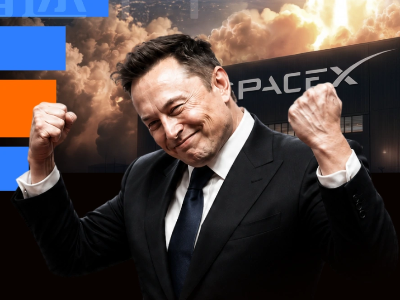
June 12, 2026, is destined to be a landmark moment in the history of global commerce and space exploration.
$SpaceX (SPCX.US)$It officially listed on Nasdaq under the ticker symbol SPCX, pricing its initial public offering at $135 per share and raising a total of $75 billion—shattering the previous record of $29.4 billion set by Saudi Aramco in 2019 and becoming the largest IPO in history.
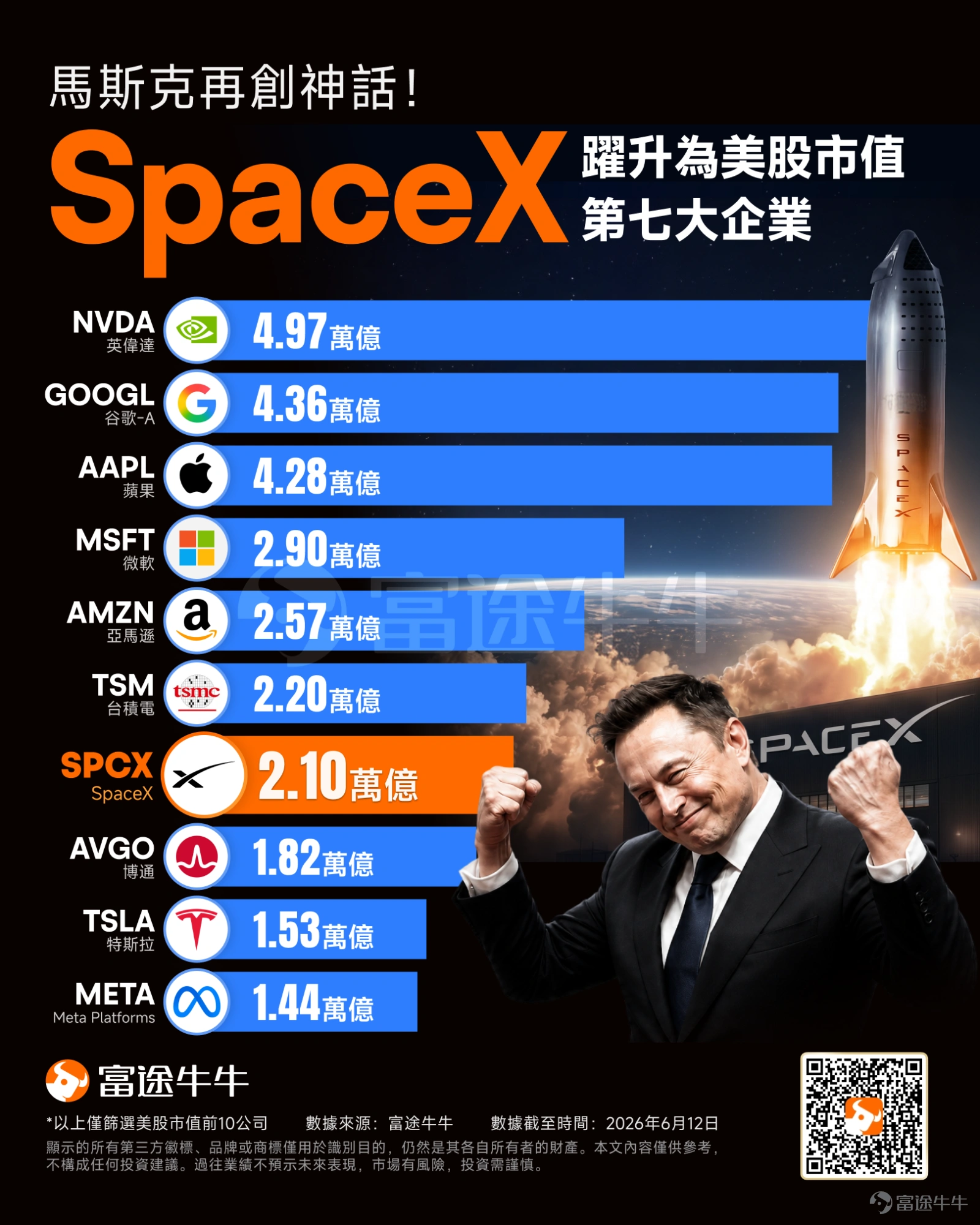
 Market enthusiasm surged on the first day of trading, with the stock opening strong and closing at $160.95—a single-day gain of 19.22%—propelling the company’s market capitalization above $2.1 trillion. With this historic IPO finalized, Elon Musk’s net worth soared to $1.1 trillion, making him the first individual in human history to achieve trillionaire status. On June 16, SpaceX shares climbed more than 16% intraday, pushing its market cap beyond $2.945 trillion and surpassing both Amazon and Microsoft to become the world’s fourth-most-valuable company.
Further reading:Elon Musk’s space computing vision revealed! SpaceX may partner with NVIDIA to enter the space-based AI sector—which companies stand to benefit?
The news flooded social media and sparked intense discussion across WeChat Moments: some hailed it as true ‘entrepreneurship among the stars and seas,’ others joked that Musk finally has ample funding to advance his Mars ambitions, while netizens playfully calculated the spending power of a trillion-dollar fortune. Yet beyond the public euphoria, global capital markets and industry analysts are all focused on one central question: where will Musk deploy this unprecedented capital windfall?
Throughout Musk’s consistent business logic, from$Tesla (TSLA.US)$to$SpaceX (SPCX.US)$he never hoards cash reserves; instead, he reinvests every dollar of profit and each round of fundraising into longer-cycle, higher-barrier frontier sectors.
His wealth has always been a lever for shaping the future.
Today, we provide an in-depth analysis of how Musk—armed with a trillion-dollar net worth and tens of billions in fresh capital—plans to allocate these vast resources, and how SpaceX’s four core business lines will evolve and compete in the coming phase.
I. Starlink: The Sole Cash Cow—Growth Concerns Lurk Beneath the Surface of Prosperity
on$SpaceX (SPCX.US)$Among its entire business portfolio, Starlink is currently the only core segment achieving scalable and stable profitability. It serves as the company’s 'cash-generating foundation' supporting high-investment R&D and constitutes the primary basis for its valuation credibility in capital markets.
According to SpaceX's latest prospectus data, Starlink generated revenue of USD 11.387 billion in 2025, an increase of 49.8% year-over-year, with operating profit reaching USD 4.423 billion and a profit margin as high as 38.8%, significantly exceeding the profitability quality of most technology companies.
The growth momentum continued into the first quarter of 2026, with quarterly revenue of USD 3.257 billion and operating profit of USD 1.188 billion. By the end of Q1 2026, Starlink’s global active subscriber base exceeded 10.3 million, with services available in 164 countries and regions, firmly cementing its position as the global leader in low Earth orbit (LEO) satellite internet.
However, behind this impressive revenue growth lies a core underlying risk: the continuous decline in average revenue per user (ARPU), which has become a focal point of market debate.
Data shows that Starlink’s ARPU declined from USD 99 in 2023 to USD 90 in 2024 and further to USD 81 in 2025, before dropping to USD 66 in Q1 2026—a year-over-year plunge of 23%.
This is not a sign of declining profitability but rather$SpaceX (SPCX.US)$a deliberate choice to pursue a global expansion strategy.
Leveraging the near-zero marginal cost of satellite bandwidth, Starlink has progressively expanded from mature, high-value markets in North America into emerging markets across Asia, Africa, and Latin America. To penetrate lower-income regions and utilize otherwise idle orbital bandwidth, the company has proactively reduced subscription pricing and distributed user terminals free of charge—trading lower prices for scale and market share for competitive moats.
This strategy has yielded significant short-term results: despite a sharp decline in ARPU, Starlink doubled its subscriber base from 5 million to 10.3 million in 2025. This explosive user growth offset the pressure from falling unit prices, driving a 58% year-over-year surge in revenue.
However, the sustainability of this approach is questionable. Starlink’s lowest-priced U.S. plan has already dropped to USD 50 per month, with even lower pricing in Europe and Africa, and ongoing free terminal distribution continues to inflate implicit costs.
More critically, Amazon’s Project Kuiper is set to launch commercially by the end of 2026, ushering in direct price competition and technological rivalry in the global LEO satellite internet market.
The红利 of trading price for volume will eventually peak. Amid intensifying industry competition, whether Starlink can maintain its high 38.8% profit margin remains uncertain.
II. xAI: A Top-Tier Cash-Burning Behemoth and a High-Stakes Bet for Breakthrough in the AI Race
If Starlink is the reliable 'cash cow' generating steady returns, then xAI is$SpaceX (SPCX.US)$the 'strategic engine' receiving full commitment and continuous heavy investment—and the primary destination for proceeds raised in this IPO.
The prospectus reveals a stark contrast in profitability: in 2025, SpaceX’s AI segment generated only $3.201 billion in revenue but incurred an operating loss of $6.355 billion—nearly $2 in losses for every $1 of revenue.
Losses widened further in Q1 2026, with quarterly revenue of $818 million and an operating loss of $2.469 billion—more than doubling the loss and far exceeding Starlink’s concurrent profits.
The primary driver of these massive losses is the enormous investment in AI computing infrastructure.
In 2025, SpaceX’s total capital expenditures amounted to $20.737 billion, of which the AI segment accounted for $12.727 billion—61% of the total—primarily allocated to building large-scale data centers and procuring high-end GPU clusters. In Q1 2026, AI-related capital expenditures surged 201% year-over-year, reaching $7.723 billion in a single quarter—already surpassing Starlink’s full-year capital spending. The pace of cash burn is nothing short of staggering.
To address gaps in AI technology and ecosystem development, SpaceX continues to intensify its strategic investments.
In April 2026, the company entered into an option agreement with Cursor, the leading AI-powered coding tool provider, granting SpaceX the right to acquire Cursor for up to $60 billion. Even if it chooses not to proceed with the acquisition, SpaceX must still pay a $10 billion termination and service fee—demonstrating its unwavering commitment to securing a leadership position in the AI race.
Simultaneously, the company secured short-term compute leasing contracts worth $1.25 billion per month from Anthropic and $920 million per month from Google, establishing NeoCloud—a compute-as-a-service business with an annualized revenue potential of $26 billion—to provide near-term cash flow support.
However, significant weaknesses remain: xAI’s Grok model lags behind industry leaders such as OpenAI and Anthropic in terms of technical maturity, ecosystem robustness, and funding scale, making a rapid leapfrog unlikely in the near term. Moreover, its current compute leasing arrangements are all short-term contracts, lacking stability and carrying a high risk of customer attrition.
Today, xAI is entirely reliant on continuous financial support from SpaceX—a high-risk, high-reward long-term bet.
III. Rocket Business: A Dream-Carrying Vehicle Under Heavy Burden and a 'Loss-Making Infrastructure' Paving the Way for the Ecosystem
Rocket launches are$SpaceX (SPCX.US)$Its foundational origin and technological bedrock, as well as the core infrastructure underpinning Starlink and its space-based computing ambitions. Yet in commercial financial statements, this business—imbued with aerospace aspirations—has consistently operated at a loss, epitomizing a 'strategic loss-leading venture.'
Data shows that in 2025, SpaceX’s space launch segment generated revenue of USD 4.086 billion but incurred an operating loss of USD 657 million. In Q1 2026, revenue stood at USD 619 million, down 28% year-over-year, while the operating loss widened to USD 662 million—exceeding the full-year loss of the previous year in a single quarter.
Two core factors underlie these persistent losses.
First, rocket launch capacity is prioritized for internal use, with minimal allocation to external commercial orders. In 2025, SpaceX completed 165 Falcon 9 launches, of which only 43 served external commercial clients; the remainder were dedicated exclusively to deploying Starlink satellites. Total payload mass for external customers amounted to 312 metric tons, while internal Starlink payloads reached 1,901 metric tons. The rocket launch business has long since departed from a pure commercial profitability model, functioning instead as a low-cost, proprietary channel dedicated to supporting its own satellite network.
Second, Starship development and testing expenditures are effectively uncapped, continuously eroding profits. As SpaceX’s next-generation fully reusable launch vehicle, Starship is pivotal to reducing orbital launch costs and realizing its broader space ambitions. To date, cumulative R&D investment in Starship has surpassed USD 15 billion. Repeated test flight failures and iterative refinements have resulted in each test campaign consuming hundreds of millions of dollars, further deepening segment losses.
However, from a holistic strategic perspective, the losses incurred by the rocket business are highly valuable. It is precisely the high-frequency, low-cost launches enabled by Falcon 9 and the technological breakthroughs achieved through Starship iterations that have fueled Starlink’s rapid user growth—adding an average of 12,000 new subscribers per day.
Although the rocket business appears unprofitable on the surface, it functions as the foundational infrastructure of the entire commercial ecosystem—trading short-term losses for long-term industry dominance and competitive moats.
IV. Space-Based Computing: Musk’s Ultimate Move to Reshape the Future Landscape of AI and Aerospace
Starlink’s cash generation, rocket development as groundwork, and AI-related capital burn are all preparatory steps. Elon Musk’s true endgame, backed by trillions in capital, lies in space-based computing power—this is the fundamental confidence enabling him to absorb sustained losses and maintain long-term, high-level investment.$SpaceX (SPCX.US)$This marks the critical transformation from an aerospace company into a 'space technology infrastructure provider.'
In February 2026, SpaceX completed its full acquisition of xAI, with the combined entity valued at $1.25 trillion. In a public letter, Musk explicitly forecast that within the next two to three years, space will become the global epicenter for AI computing power—offering the lowest costs and highest efficiency—thereby completely overcoming the energy and heat dissipation constraints of terrestrial data centers. This ultimate strategy rests on two core pillars.
First, establishing orbital AI data centers. Leveraging Starship’s ultra-high payload capacity, SpaceX plans to conduct thousands of launches annually, deploying hundreds of tons of computing-capable satellites per mission, delivering a total of 100 gigawatts of AI computing power per year.
Compared to ground-based data centers, space environments offer inherent advantages: no day-night cycles and no atmospheric attenuation, resulting in solar energy utilization efficiency five times higher than on Earth; the frigid temperatures of space enable direct radiative cooling, eliminating 40% of the energy consumption required for cooling on Earth, thereby fundamentally addressing the two primary bottlenecks of AI computing power.
Second, scaling up to a million-satellite computing cluster. SpaceX has submitted an application to the FCC proposing the deployment of up to one million computing-capable satellites—23 times the scale of its existing Starlink constellation plan of 42,000 satellites—to provide comprehensive hardware coverage for its space-based computing network.
Simultaneously, the company has launched the Terafab supercomputing initiative, with a long-term goal of building a 1-terawatt supercomputing capability to reshape the global computing power supply landscape.
However, realizing this ultimate vision faces immense technical challenges and extremely high costs.
Industry estimates indicate that current operating costs for space-based computing power are three to five times higher than those on Earth. Achieving commercial breakeven will require full reusability of Starship to reduce launch costs from $2,500 per kilogram to below $500 per kilogram. The Starship V3 variant has just completed its first test flight, and the technology remains immature; scalable, low-cost operations will require prolonged iterative development.
V. The Funding Reality: Trillion-Dollar Valuation Is Illusory; Billions Raised Are Real—All Bets Are on the Future
Many mistakenly believe that Elon Musk has $1.1 trillion in freely deployable capital, but this is not the case. The vast majority of this enormous wealth consists of unrealized paper gains that cannot be liquidated immediately.
This IPO $SpaceX (SPCX.US)$will issue 555.6 million Class A ordinary shares, representing only 4.2% of total outstanding shares, raising USD 75 billion. Elon Musk and core investors collectively hold 7.8 billion shares, subject to a lock-up period of 366 days, expiring on June 13, 2027.
In other words, the trillion-dollar valuation reflects a premium assigned by capital markets; the actual cash firepower available to the company consists solely of the USD 75 billion raised in this IPO and potential proceeds from future secondary offerings.
Musk has already allocated this scarce capital to clearly defined and aggressive priorities: AI computing infrastructure ranks first, followed by Starship development and iteration, global expansion of Starlink, and deployment of space-based data centers.
Based on its AI investment pace in Q1 2026, SpaceX’s full-year AI-related capital expenditures are projected to exceed USD 30 billion—nearly exhausting its core operating cash flow—as it aggressively bets on the emerging space-AI frontier.
VI. Five Key Risks Lurking Beneath the Surface; Trillion-Dollar Valuation Bubble Awaits Correction
Soaring on its IPO debut and crowned with a trillion-dollar market valuation, it appears immensely successful on the surface, yet$SpaceX (SPCX.US)$its fundamentals harbor multiple underlying concerns, with significant divergence among capital market participants and substantial long-term risks that cannot be ignored.
First, the valuation bubble is pronounced. The IPO price implies a sky-high price-to-sales (P/S) ratio of 95x for SpaceX, while the company has accumulated a deficit of USD 41.3 billion—creating a severe mismatch between fundamentals and its inflated valuation. Wall Street analysts are sharply split: Oppenheimer set a target price of USD 190, whereas CFRA sees only USD 115—a USD 75 gap equivalent to 56% of the IPO price. Historically, tech stocks that surge on their listing day typically experience significant pullbacks within 12 months, indicating immense pressure for valuation normalization.
Second, the AI business continues to bleed cash, straining liquidity. SpaceX reported a net loss of USD 4.94 billion for the full year 2025, with losses widening further in Q1 2026. If xAI fails to achieve profitability quickly and Starlink’s capital expenditures keep rising, the company could face a scenario where internal cash generation slows while burn rates accelerate, steadily eroding its cash flow safety margin.
Third, core operations are heavily dependent on Starship, creating a single point of failure. Next-generation satellite deployment, space-based computing, and reduced launch costs all hinge on Starship achieving mass production and technical maturity. Any setback in Starship’s development or test failures would stall the company’s entire medium- to long-term strategy, with no viable fallback plan.
Fourth, industry competition and regulatory barriers are intensifying. Amazon’s Project Kuiper is nearing commercialization, directly threatening Starlink’s market share; meanwhile, OneWeb leverages polar orbits and government backing to capture differentiated segments. Additionally, regulatory scrutiny over satellite internet access is tightening in key markets such as China, India, and Russia, posing hard barriers to global expansion.
Fifth, risks to the space ecological environment are becoming increasingly evident. Starlink currently has over 11,000 satellites in orbit, and continuous,密集 launches have led to congestion in low Earth orbit, significantly heightening the risks of satellite collisions and space debris pollution. Without effective governance solutions, these issues will not only constrain Starlink’s own operations but also impede the global space industry’s development, potentially triggering stricter regulatory oversight.
Seven: Musk’s Strategic Breakthrough Logic—Short-Term Cash Generation, Medium-Term Cost Reduction, Long-Term Ecosystem Creation
Beneath an apparently pressured business landscape lies Musk’s clear three-tiered growth strategy, with each strategic move intricately linked and progressively advancing toward long-term objectives.
In the short term, Starlink stabilizes the foundation: continuously trading price for volume to solidify its global market share, advancing Starlink Mobile’s direct-to-cellphone satellite connectivity to capture the 40% of the world’s population currently lacking network coverage. Simultaneously, it plans to invest USD 17 billion to acquire EchoStar’s mobile spectrum assets, bridging the gap between satellite and terrestrial mobile communications and establishing a new profit curve to sustainably fund the broader corporate ecosystem.
In the medium term, Starship drives down costs: accelerating Starship mass production and iterative testing to achieve fully reusable, aviation-grade routine operations as soon as possible, reducing launch costs to below USD 500 per kilogram. Only by fundamentally resolving launch cost challenges can commercialization of space-based computing and mega-constellations comprising millions of satellites become viable.
In the long run, dominance will be determined by space-based computing: continuously deploying orbital data centers to shift AI computing capacity from Earth to space, thereby overcoming the twin industry bottlenecks of energy consumption and heat dissipation. This is a decade-plus strategic initiative; once realized,$SpaceX (SPCX.US)$it will fully shed its identity as an aerospace company and emerge as the global monopolist in space-based AI infrastructure.
Throughout this journey, capital buys time: leveraging IPO proceeds amounting to tens of billions of dollars and a trillion-dollar valuation to continuously attract long-term strategic capital, using robust cash flow to hedge against the risks inherent in extended R&D cycles and securing critical iteration time for the full ecosystem rollout.
Epilogue: He never sought to make money—he only wanted to use money to rewrite humanity’s future.
On the day of SpaceX’s IPO, Musk delivered a live address from Starbase in Texas, with a vast Martian vista visible in the background. Speaking to a global audience, he declared, “It won’t just be a handful of astronauts—every ordinary person will have the chance to set foot on the Moon, journey to Mars, and venture even farther into the cosmos.”
He once likened human consciousness to a fragile, flickering candle flame in the darkness of the universe—small yet precious, and ever vulnerable to extinction. His lifelong entrepreneurial mission has been to safeguard that flame and secure humanity’s path toward survival and expansion.
Looking back at his capital logic, it has never been about 'earning to consume,' but rather 'earning to invest': using Starlink’s stable profits to fund the high-burn xAI; leveraging xAI’s cutting-edge computing power to accelerate Starship technology iteration; utilizing Starship’s low-cost launch capacity to build space-based computing infrastructure; and ultimately supporting humanity’s ultimate vision of a multiplanetary civilization through a thriving space computing ecosystem.
So returning to the original question: where exactly will Musk’s trillion-dollar fortune and billions in fundraising be spent?
The answer has long been clear: he has never viewed money as wealth, but solely as a tool to propel the future. He does not squander a single dollar; instead, he channels all his capital toward humanity’s journey among the stars.
While we observers worry about profits and losses and fret over risks, Musk has already transcended the conventional business calculus of profitability. Through a decade-long audacious bet, he seeks to redefine the very boundaries of human civilization. In the future, what we may truly anticipate is not merely rising stock prices or profitable operations, but the liftoff of Starships, the deployment of space-based computing infrastructure, and the day ordinary people set foot on Mars.
After all, the ticket to our dreams is expensive—but worth the journey.
Editor /rice