
Waller sent a strongly hawkish signal, prompting markets to swiftly reassess the outlook for the U.S. dollar: the dollar index posted its largest two-day gain in three months, and options markets saw a surge in large-scale bullish bets on the dollar. Traders have begun pricing in a potential Federal Reserve rate hike as early as July, bolstering the appeal of dollar-denominated assets, while major currencies such as the euro and yen came under broad pressure.
The Federal Reserve's new Chair, Kevin Warsh, sent a strongly hawkish signal in his first monetary policy meeting since taking office, reigniting bullish sentiment on the U.S. dollar and prompting a pivotal shift in market views on the greenback’s trajectory.
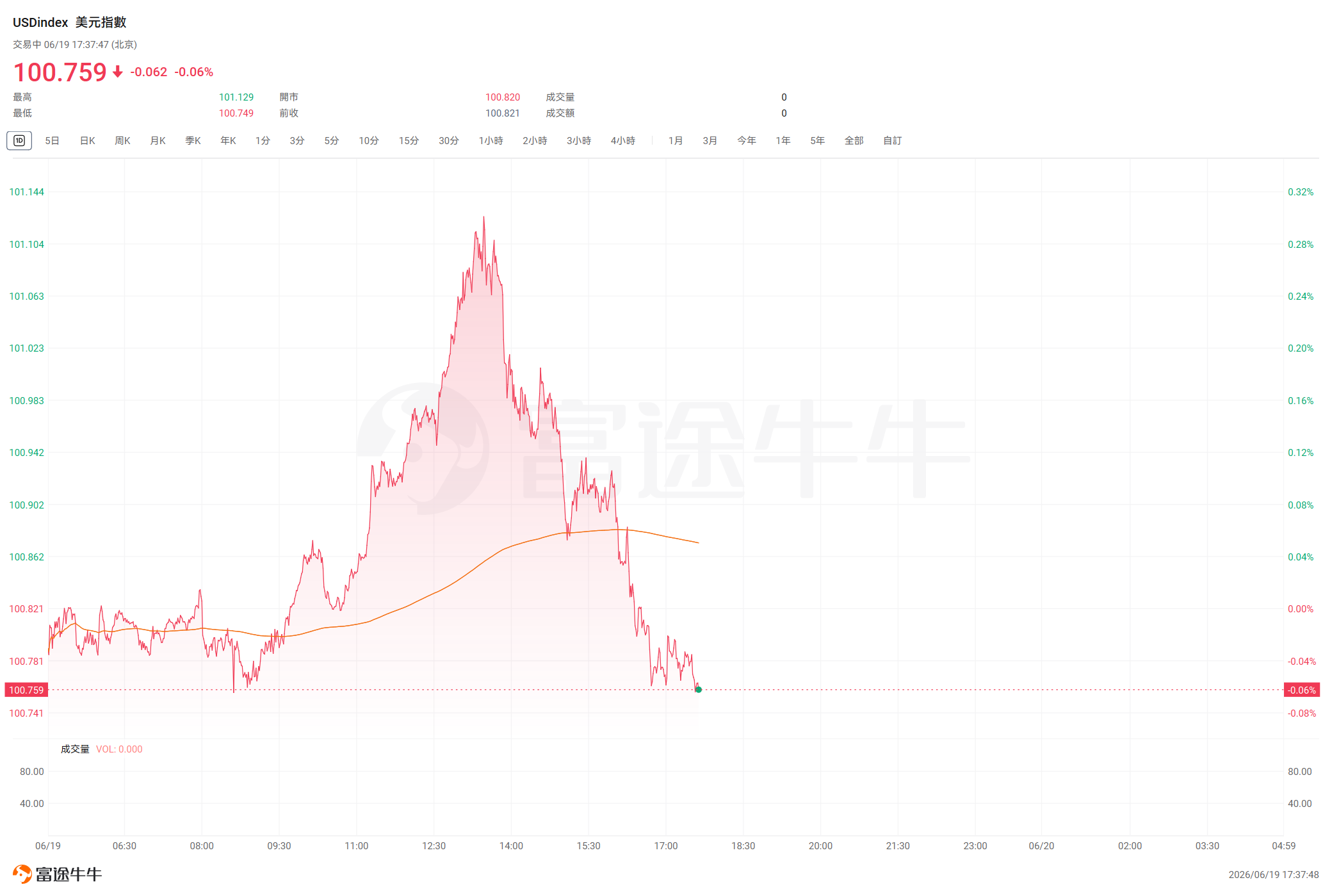
The U.S. Dollar Spot Index rose by approximately 1% over Wednesday and Thursday combined—the largest two-day gain in three months—approaching its late-March high for the year. Futures markets have fully priced in a 25-basis-point rate hike by the Fed before October, with some traders even eyeing July as a possible window. The euro fell to its lowest level since late March, the Canadian dollar weakened to its softest point since April 2025, and the yen slid to a near two-year low.
 The options market reaction was especially pronounced. According to Bloomberg, citing multiple traders, hedge funds and leveraged accounts aggressively bought U.S. dollar call options starting Wednesday. Euro-dollar options trading volume surged to its highest level since March 3, while sterling-dollar call option volume exceeded put option volume by more than fivefold.
Alex Cohen, foreign exchange strategist at Bank of America, described the meeting as "undoubtedly hawkish and therefore undoubtedly positive for the dollar," while Jane Foley, head of currency strategy at Rabobank, said the meeting had "reactivated" dollar bulls.
Hawkish Debut Rewrites Market Narrative
In his first press conference as Fed Chair, Kevin Warsh emphasized the central bank’s inflation-fighting mandate with unusually firm language, prompting markets to reprice expectations. Lee Hardman, strategist at MUFG Bank, stated that the Fed’s hawkish policy update "is threatening to trigger a bullish breakout in the dollar," an effect that has already outweighed the dollar-negative impact of the U.S.-Iran peace agreement.
Bloomberg strategists also noted that prior market expectations of a dovish Fed bias had been a key factor weighing on the dollar—a narrative now rapidly unraveling after the latest FOMC meeting. As market focus shifts back from geopolitical developments in Iran to U.S. economic data, the dollar is poised for further support.
Following the signing of the U.S.-Iran peace agreement, oil prices retreated slightly, redirecting market attention to U.S. economic fundamentals. U.S. inflation recently accelerated to around 4%—a three-year high and roughly double the Fed’s 2% target—primarily driven by an AI investment boom and energy price shocks.
Massive Bullish Bets Emerge in Options Market
The sharp shift in options positioning vividly reflects the market’s changing sentiment. Tobias Jungmann, head of foreign exchange options in New York at Bank of America, stated, "We are seeing substantial demand for U.S. dollar call options," primarily concentrated in G10 currencies, adding that the current low levels of implied volatility make establishing long dollar positions via options "particularly attractive."
James Swindell, senior FX options trader at Barclays, stated, "We are seeing a broad-based surge in demand for U.S. dollar call options, particularly evident in EUR/USD and GBP/USD, manifesting through various instruments including vanilla and digital options."
According to CME Group data, trading volume for USD/GBP call options on Thursday exceeded that of put options by a factor of five. Meanwhile, DTCC data showed that EUR/USD options trading volume rose to its highest level since March 3 of this year, with large notional call contracts of €200 million (approximately $229 million) or more trading at nearly twice the volume of similarly sized put contracts.
Rising rate hike expectations widen yield differentials, restoring appeal of dollar-denominated assets
After futures traders priced in a 25-basis-point Fed rate hike in September as the base case, short-term U.S. Treasury yields rose significantly, further widening yield differentials with many other countries and providing fresh impetus for global investors to shift into dollar assets. Record-breaking trading volumes in Treasury futures markets during the same period further reinforced market bets that the Fed’s next move would be a rate hike.
According to Bloomberg-compiled Commodity Futures Trading Commission (CFTC) data, as of June 9, hedge funds, asset managers, and other speculative accounts held a combined net long position of $27.78 billion in the U.S. dollar—the highest since February 2025. The latest positioning data is expected to be released this Monday.
Ugo Lancioni, senior portfolio manager at Neuberger Berman, which manages $576 billion in assets, noted that while the firm remains bearish on the dollar over the medium term—primarily due to stretched valuations—"robust U.S. macroeconomic data, inflationary pressures stemming from energy shocks, and the AI investment cycle continue to provide underlying support for the dollar."
Divergent views emerge on yen direction, with intervention risk complicating positioning
The Japanese yen stands out as a notable exception in this latest dollar rally. Having weakened to its lowest level since July 2024, it has sparked market concerns about potential intervention by Japan’s Ministry of Finance. On Friday, Finance Minister Satsuki Katayama stated that the government could take "bold action" against speculative currency movements.
James Swindell pointed out that regarding USD/JPY direction, "the market shows clear divergence: some clients are betting on further upside in USD/JPY, while others are positioning for a sharp reversal triggered by potential intervention."
This divergence has led to$USD/JPY (USDJPY.FX)$a more balanced options positioning compared to currencies such as the euro and the British pound, and has also made the overall dollar bullish trend relatively muted in the yen direction.
Editor/melody