Bernstein forecasts that in Q3 2026, contract price increases for both DRAM and NAND will narrow to approximately 20%, as weak demand from PCs and smartphones and price ceilings in long-term agreements constrain further upside. Although supply shortages are expected to persist into 2027, the room for further memory price increases has become limited, suggesting the current price rally may be nearing its end.
The momentum behind rising memory chip prices is clearly decelerating. According to the latest data from Bernstein, sequential contract price increases for both DRAM and NAND in the third quarter of 2026 have narrowed to approximately 20%, a significant slowdown compared to the second quarter and potentially below recent market expectations. Although supply shortages are expected to persist into 2027, upside pricing pressure is being constrained by weakening demand-side support and price ceilings embedded in long-term agreements.
U.S. memory stocks collectively pulled back today, $SK hynix (SKHY.US)$ 、 $Western Digital (WDC.US)$ falling nearly 6%, $SanDisk (SNDK.US)$Down more than 4%,$Micron Technology (MU.US)$ fell nearly 3%.
 According to the ZhuiFeng trading desk, Bernstein’s July memory price tracking report shows that July contract prices indicate a sequential increase of approximately 17% for conventional DRAM in the third quarter—slightly above Bernstein’s own model forecast but possibly below some of the market’s more recent expectations. For NAND, including SSDs in the calculation yields an overall increase close to 20%, broadly in line with the model, though still potentially falling short of the most optimistic forecasts.
In the report, Bernstein analyst Mark Li noted that memory is increasingly becoming a cost burden for both AI and non-AI applications, and price caps stipulated in certain long-term agreements (LTAs) are further limiting room for additional price hikes. He believes the recent stock price correction presents an opportunity for a short-term technical rebound, but the upside potential for prices has become increasingly limited.
DRAM: Strong server demand offset by mounting headwinds in PCs and smartphones
The DRAM market is exhibiting clear internal divergence.
Server demand remains robust, with customers anticipating further tightening of supply in 2027 and demonstrating strong willingness to build inventory. According to TrendForce, server DRAM contract prices rose 8% to 15% month-over-month in July, with an estimated third-quarter sequential increase of 13% to 18%. However, for clients under LTAs containing price ceilings, July prices have already approached the contractual cap, creating a noticeable gap versus quotes for non-LTA clients.
In contrast, the PC and smartphone segments are showing markedly different trends. PC DRAM contract prices increased 13% to 16% month-over-month in July, with a projected third-quarter sequential rise of around 17%. However, OEMs have raised end-product prices due to higher memory costs, leading to an expected decline in PC shipments of over 10% quarter-over-quarter in Q3 and a corresponding sharp drop in procurement appetite.
For mobile DRAM, TrendForce forecasts a third-quarter sequential contract price increase of approximately 10%, a notable deceleration from Q2. Following cuts to smartphone production plans, mobile OEMs have shown significantly stronger resistance to further price hikes. Looking ahead to Q4, TrendForce expects the mobile DRAM price increase to narrow further into single digits.
Consumer DRAM has performed relatively strongly, with July contract prices rising 12% to 16% month-over-month and an expected third-quarter sequential increase of 24% to 30%. However, TrendForce observes that spot prices have started to lag behind contract prices, suggesting demand may be peaking.
NAND: Wafer price momentum fades; SSDs emerge as primary support
The divergence in the NAND market has become more pronounced.
Wafer contract prices remained largely flat in July, as module manufacturers—facing weak consumer demand—refused to accept further price increases, resulting in severely contracted trading volumes. According to TrendForce, under the current backdrop of sluggish consumer demand, module makers believe NAND wafer prices are already elevated and prefer to draw down their existing inventories.
Mobile NAND (eMMC/UFS) performed relatively better, with TrendForce forecasting a quarter-over-quarter price increase of approximately 20% in Q3, primarily driven by catch-up pricing aimed at aligning profitability with that of eSSDs. Notably, Chinese suppliers have secured greater shipment share in this round of price hikes due to their relatively lower asking prices.
SSDs remain the core pillar supporting the NAND segment. Bernstein estimates that client and enterprise SSD contract prices will rise by approximately 20% quarter-over-quarter in Q3, lifting the overall NAND price increase to nearly 20%. However, the firm also notes that the pace of NAND price appreciation will continue to decelerate, with the peak likely occurring at some point in 2027, and intensifying competition from China exerting structural downward pressure.
A short-term rebound window exists, but upside potential is becoming increasingly limited.
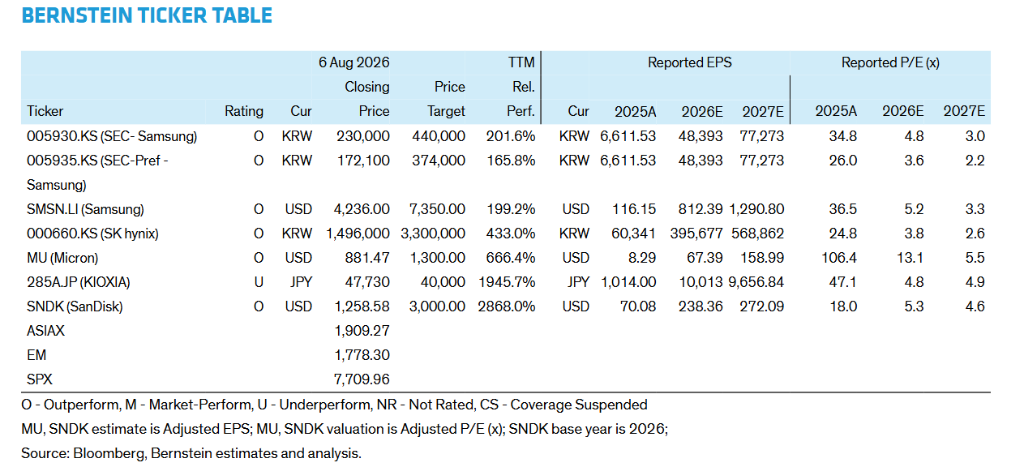
Bernstein maintains its 'outperform' rating on Samsung Electronics, SK Hynix, Micron, and SanDisk, with target prices of KRW 440,000, KRW 3,300,000, USD 1,300, and USD 3,000, respectively; it retains a 'underperform' rating on KIOXIA with a target price of JPY 40,000.
The firm believes the memory supply shortage will persist through 2027, keeping prices elevated, though the scope for further increases has been significantly constrained.
On one hand, PC and smartphone customers have stabilized or even increased their inventory levels, and after substantially cutting shipment plans, their willingness to accept price hikes has declined markedly. On the other hand, price ceilings embedded in certain long-term agreements (LTAs) are capping server DRAM price increases. Furthermore, persistently rising memory costs are beginning to weigh on both AI and non-AI applications, and signs of demand-side pressure cannot be ignored.
Bernstein notes that the recent pullback in memory stocks presents a near-term entry opportunity for technical rebounds, but investors should remain cautious about the risk that the price-hike cycle is entering its final phase—the peak may already be within sight rather than distant.
Editor/Deng