After evaluating all pilot sites, SemiAnalysis believes that$SpaceX (SPCX.US)$the target of adding over 10 GW of computing capacity by 2027 is achievable.$Microsoft (MSFT.US)$Due to a significant demand shortfall, it could sign a 3 GW contract with SpaceX valued at approximately $150 billion, becoming its largest computing capacity customer. If half of the newly added capacity is allocated to commercial inference, SpaceX’s annual recurring revenue (ARR) could reach $300 billion by the end of 2027.
SpaceX is transitioning into a hyperscale computing capacity provider at a pace exceeding market expectations.
According to a recent report by research firm Semianalysis, SpaceX is on track to add more than 10 GW of computing capacity by the end of 2027, potentially generating up to $300 billion in annual recurring revenue (ARR), with Microsoft expected to become its largest customer.
 Previously, at SpaceX’s first earnings presentation, Elon Musk announced the company’s “conservative” target of building and delivering 6 to 8 GW of additional computing capacity in 2027 alone, with upside potential exceeding 10 GW. Based on a capital expenditure estimate of $50 billion per GW, this implies a 2027 capex range of $300 billion to $500 billion—comparable to the projected investments of AWS and Google—a figure that has stunned markets given SpaceX’s significantly lower profitability relative to mainstream hyperscale cloud providers.
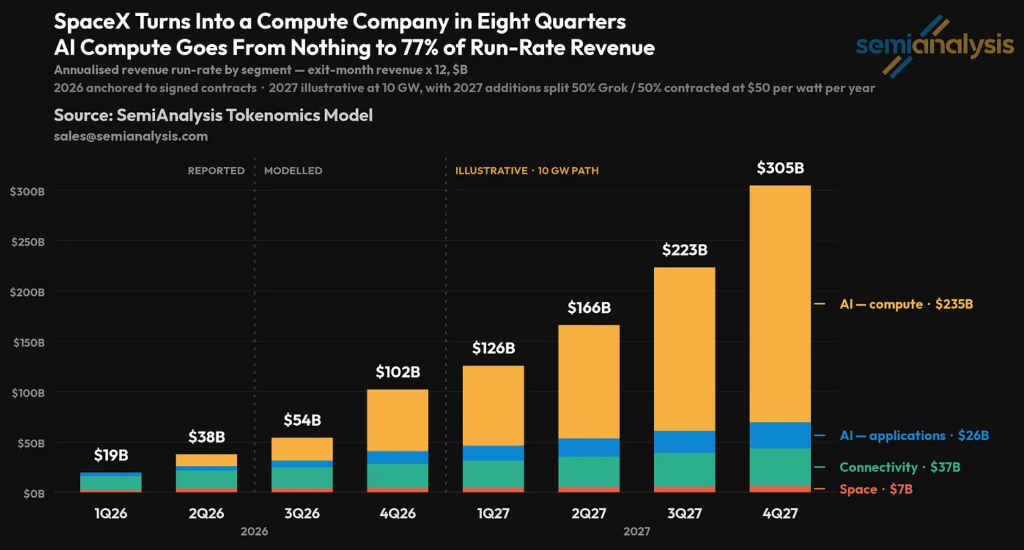
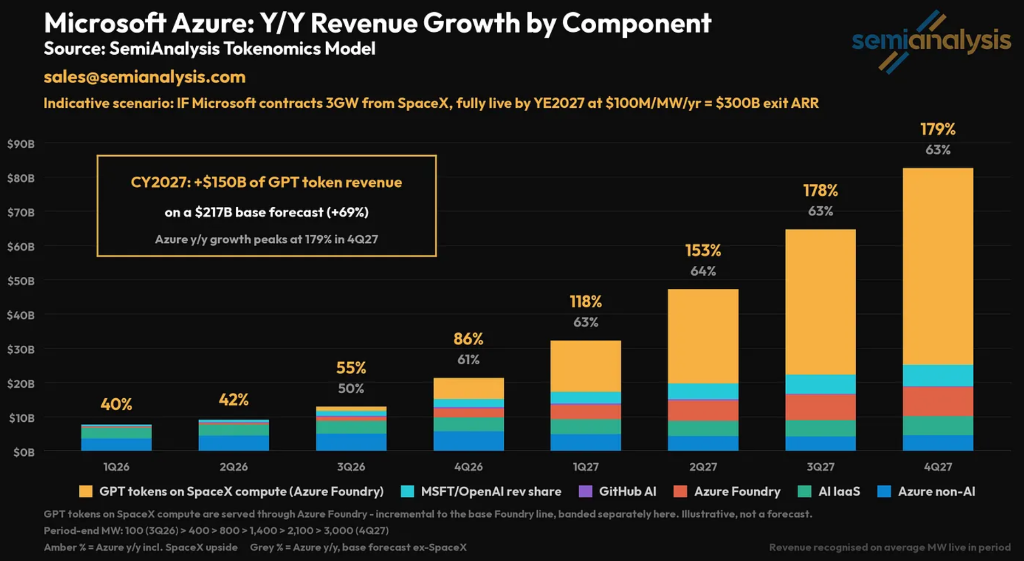
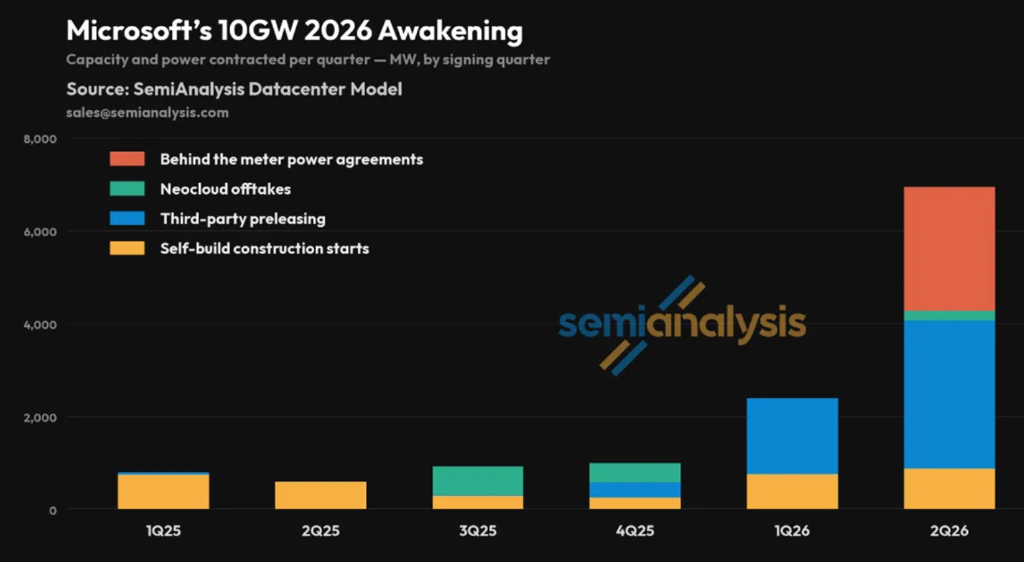
Semianalysis stated it has evaluated all viable SpaceX construction sites and is tracking available natural gas-powered generation equipment on a quarterly basis, concluding that the aforementioned targets are realistically achievable. The report also noted that Microsoft has signed over 10 GW of data center contracts year-to-date, with total contract value exceeding $300 billion, and that Microsoft’s potential demand for SpaceX’s computing capacity could be the key driver propelling Azure’s revenue growth rate from approximately 42% to over 100%.
Exceptionally high margins in inference computing are fueling explosive demand.
Semianalysis’s core thesis rests on the high profit margins of AI inference services.
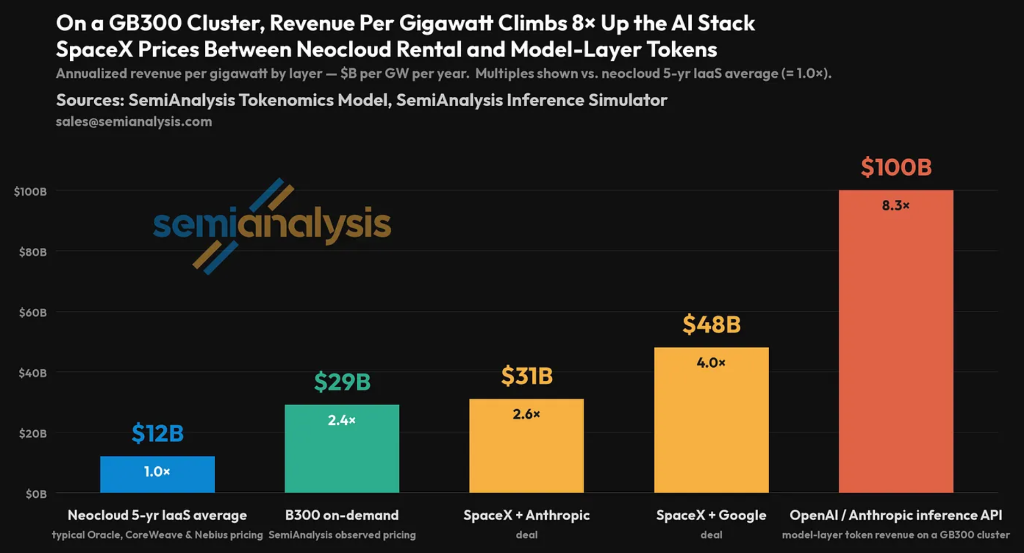
According to the firm’s Tokenomics model and inference simulator, when OpenAI and Anthropic provide API-based inference services on GB300 clusters, each gigawatt (GW) can generate over $100 billion in annual revenue. Assuming a conservative GPU lease rate of $3 per hour, the annual cost per GW amounts to approximately $12 billion, resulting in inference gross margins exceeding 60%, with some flagship models achieving margins above 85%.
This economic model applies equally to Microsoft.
Semianalysis pointed out that in its April 2026 renegotiation of the OpenAI agreement, Microsoft eliminated the original 20% revenue-sharing clause. This means Microsoft can now achieve per-megawatt revenue and margins comparable to those of OpenAI and Anthropic when offering inference services using OpenAI models, while bearing none of the training costs.
The report characterizes this situation as a 'once-in-a-century opportunity.'
Microsoft's computing capacity shortfall opens a window for SpaceX
Microsoft had significantly slowed its data center leasing activities by the end of 2024, but according to Semianalysis, this situation reversed entirely between 2025 and 2026.
In October 2025, Microsoft signed an infrastructure-as-a-service agreement with OpenAI valued at USD 250 billion. Semianalysis estimates this deal corresponds to approximately 7 GW of computing capacity, severely constraining Microsoft’s Foundry API business and applications such as Copilot.
To address this shortfall, Microsoft has signed binding contracts totaling over 10 GW year-to-date across multiple dimensions, including leases, self-built facilities, and long-term power purchase agreements.
Semianalysis considers it "not impossible" that Microsoft and SpaceX could sign a 3 GW contract worth approximately USD 150 billion, citing two reasons: first, Microsoft is already in a large-scale computing capacity expansion cycle; second, SpaceX offers a 90-day termination clause—consistent with its contracts with Anthropic and Google—resulting in minimal financial risk and facilitating internal approval.
SpaceX’s construction speed: Disrupting industry norms
Semianalysis attributes SpaceX’s competitive advantage to its systematic disruption of traditional data center construction logic.
The report cites several specific examples: the 300 MW Colossus 1 facility was completed in just 122 days; the Southaven power plant expanded from 27 gas turbines (approximately 495 MW) in February 2026 to 69 turbines (1.7 GW) by July 2026; and the 'MiniHard' project began vertical construction in March 2026 and is expected to reach 450–500 MW within approximately five months.
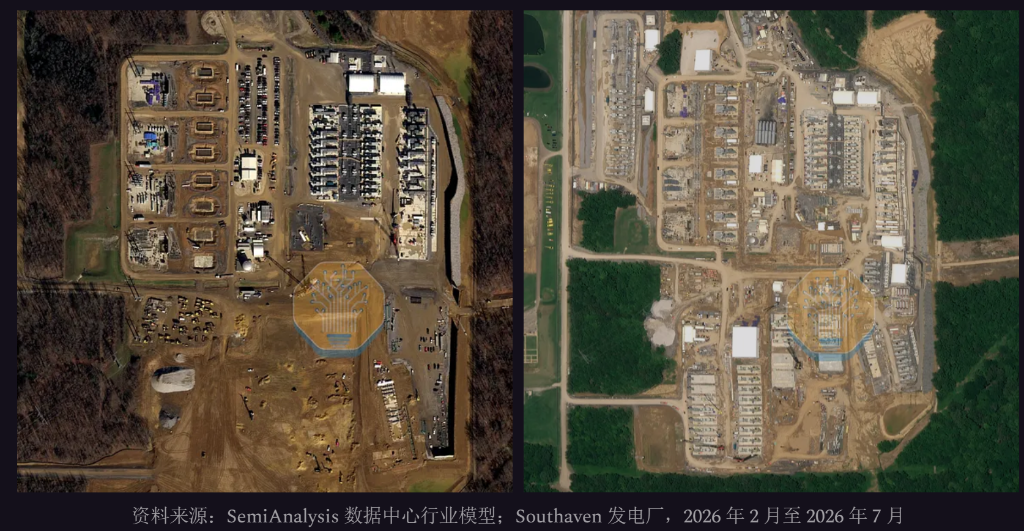
To address supply chain bottlenecks, SpaceX has implemented a series of unconventional strategies: replacing large power transformers—backlogged for over two years—with Chinese-made power modules; procuring gas turbines on the secondary market (including units originally intended for delivery to the New Mexico site); and compressing commissioning timelines through highly parallelized construction and pre-assembly.$Oracle (ORCL.US)$Colossus 2 peaked at approximately 3,000 workers per day, significantly below the industry average for data centers of comparable scale.
Semianalysis notes that SpaceX’s core competitiveness lies in prioritizing 'speed over efficiency,' overturning the industry’s conventional logic. In today’s environment of extreme computing scarcity and high AI inference margins, a 500 MW cluster deliverable within three months and accompanied by a 90-day termination clause represents one of the market’s rarest assets. Google’s ultimate decision to sign with SpaceX strongly validates this approach.
Financing Pathway:$NVIDIA (NVDA.US)$Vendor financing and cash flow roll-forward
In response to external skepticism regarding SpaceX's capital strength, Semianalysis outlined two potential financing pathways.
First, NVIDIA could reduce SpaceX’s upfront cash outlays through supplier financing—an arrangement widely viewed as a key reason behind Musk’s announcement during the earnings call that SpaceX would exclusively adopt NVIDIA chips, despite having previously evaluated alternatives such as TPUs and AMD. Second, leveraging the industry’s fastest delivery cycle, SpaceX commands a premium pricing of $30–50 million per megawatt annually, enabling it to recoup capital expenditures within less than a year through operating cash flow.
Taking these factors into account, Semianalysis forecasts that if only 50% of SpaceX’s新增算力 in 2027 is allocated to commercial inference monetization (with the remainder used for training by the Grok and Cursor teams), SpaceX’s annual recurring revenue (ARR) could reach $300 billion by the end of 2027.
Editor / Rocky